
Have you used a scented candle or a diffuser and felt instantly relaxed and refreshed? So, you are not simply taking in and experiencing the fragrance and the freshness; you are truly immersing and engaging yourself in the world of scented oil. However, have you ever stopped to wonder what the key difference is between essential and fragrance oils? For formulators, brands, and consumers, knowing this distinction is more than just semantics; it is about safety, performance, and value.
Did you know that the essential oil market was at USD 25.86 billion in 2024 globally, and it is expected to reach USD 56.25 billion by 2033? Meanwhile, the global fragrance oil market was valued at USD 8.50 billion in 2024, and by 2032, it is projected to increase to USD 11.90 billion.
These figures underscore that while “natural” is trending, synthetic fragrance solutions still dominate large-scale scent applications. In this guide, we are going to explore some other differences between fragrance oils and essential oils.
What Are Essential Oils?
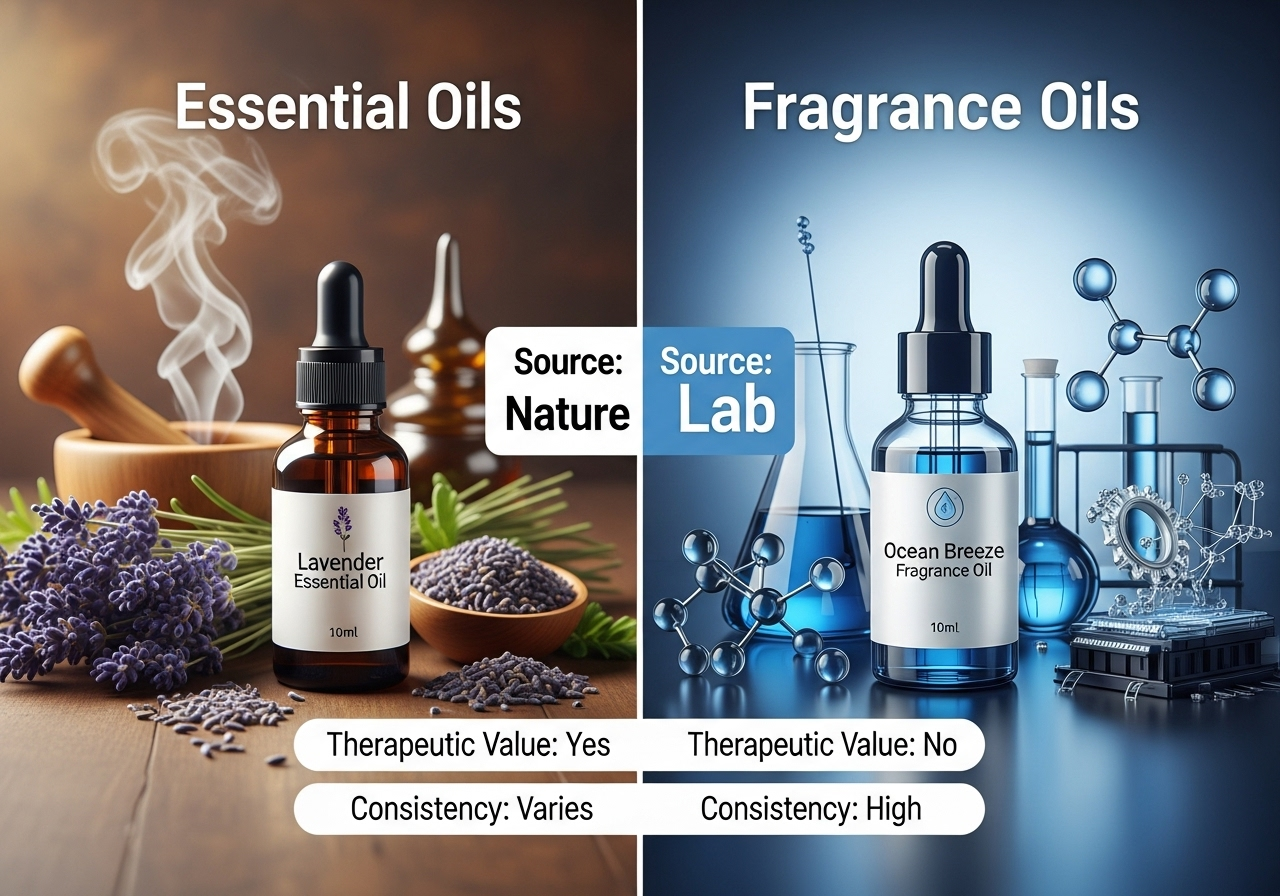
Essential oils are volatile, hydrophobic liquids that contain aromatic compounds naturally derived from plants (flowers, leaves, bark, roots, resin, etc.). They are obtained via steam distillation, cold pressing (expression), solvent extraction, or CO₂ extraction.
The term “essential” here refers to capturing the essence or fragrant character of the plant, not to the oil being “essential” in a dietary or nutritional sense.
Since these oils are extracted naturally, the chemical composition can vary considerably. Some factors for variation include plant, climate, harvest time, and distillation parameters.
Many essential oils have low flash points, meaning they can degrade or become unstable under high heat (relevant in candles).
They can also be irritating or sensitising to the skin, mainly when used in concentrated form. Even “natural” labelled essential oils don’t guarantee safety; dermatologists often caution that essential oils are potent and should be handled with care.
What Are Fragrance Oils?
Fragrance oils are alternatively called synthetic fragrance oils and aroma compounds. These are formulated scent blends created in laboratories by combining synthetic aroma chemicals with optional natural extracts/resins.
Many perfume-grade fragrance oils may contain dozens of individual components, and luxury fragrances may use even more to create complexity. Because they can incorporate synthetic aroma chemicals, fragrance oils enjoy a broad palette, not possible with nature alone (e.g., “fresh ocean breeze”, “champagne”, and abstract gourmand accords).
They are way more resilient to oxidation, light, and heat. This helps for formula stability in cosmetics, candles, soaps, and consumer goods. The presence of synthetic chemicals means allergenic potential increases; some molecules might cause irritation or sensitivities in sensitive individuals.
Also, when it comes to fragrance oils, transparency can be an issue: fragrance houses may not fully disclose all specific molecules due to trade secrets, making full risk assessment difficult.
What is the Difference Between Essential Oils and Fragrance Oils: Side-by-Side Comparison
The terms ‘essential oils’ and ‘fragrance oils’ may seem the same, but they are also used interchangeably and are quite distinct from one another. Understanding the key difference between fragrance oils and essential oils isn’t just about scent preference; it’s about safety, performance, sustainability, and product innovation.
Here is a side-by-side comparison:
| Parameters of Comparison | Essential Oils | Fragrance Oils |
| Source & Composition | 100% natural extracts derived from plants (flowers, leaves, bark, roots, peels, or resins). Contain naturally occurring volatile compounds like terpenes, alcohols, and esters. | Lab-created blends of natural and synthetic aromatic compounds designed to mimic or enhance scents. May contain both natural isolates and aroma chemicals. |
| Extraction Method | Obtained through steam distillation, cold pressing, or CO₂ extraction. | Created through synthetic formulation and blending by perfumers or fragrance chemists. |
| Consistency & Batch Variation | Varies from batch to batch depending on plant quality, harvest time, and climate. | Extremely consistent; scent profile remains uniform across batches. |
| Aroma Strength & Longevity | Light to moderate scent throw; tends to evaporate quickly due to volatility. | Strong and long-lasting scent throw; engineered to project and last longer. |
| Therapeutic Value | Often used in aromatherapy for potential psychological or physical benefits (e.g., relaxation, decongestion). | Primarily aesthetic; designed for fragrance appeal, not therapeutic use. |
| Heat & Oxidation Stability | Sensitive to heat, light, and oxygen; can lose potency or degrade. | More stable under heat and UV exposure; maintains integrity in candles and soaps. |
| Shelf Life | Typically 1–3 years (based on storage and oil type). | Can last 5+ years with proper storage due to added stabilisers. |
| Safety & Allergens | Natural origin doesn’t mean allergen-free; can cause irritation if undiluted. Requires careful concentration limits. | Can contain synthetic allergens; have to comply with IFRA (International Fragrance Association) safety standards. |
| Cost & Scalability | Higher cost due to plant yield, extraction labour, and seasonal availability. | More cost-effective and scalable for mass production. |
| Environmental Footprint | Sustainable if ethically sourced, but large-scale farming can strain resources. | Lower agricultural impact, but production of synthetics may involve petrochemical derivatives. |
| Applications | Aromatherapy, natural skincare, organic perfumery, wellness products. | Perfumes, candles, soaps, lotions, air fresheners, detergents, and cosmetics. |
| Regulatory Oversight | Must meet purity and labelling standards (e.g., ISO, ECOCERT). | Must adhere to IFRA and cosmetic safety regulations. |
Applications & Use Cases: When to Use Which?
When it comes to the difference between fragrance oil and essential oils, the application and use cases are quite significant. Let us look at the different applications and use cases of both:
1. Candles, Soaps & Home Fragrance
Fragrance oils are known to outperform essential oils in candle making, as they can offer better scent throw and heat stability. The same goes for soaps.
However, when it comes to diffusers, essentials are more prominently used for the appeal of natural aroma.
2. Aromatherapy & Wellness Products
If your intention is therapeutic or wellness-driven use (massage blends, inhalation, diffusers for stress or respiratory support), essential oils are generally preferred.
Fragrance oils are generally not advised for therapeutic use. They are engineered for scent rather than wellness products.
3. Cosmetics & Skincare
Fragrance oils are often used in mass-market skincare and personal care because of cost, stability, and control. But brands must ensure they meet fragrance allergen labelling requirements and safe use levels.
If essential oils are used, it is always in low concentrations (typically under 1%) and only after patch testing. They add botanical branding appeal, scent, and possibly mild functional benefits (antimicrobial, anti-inflammatory, etc.).
4. Perfumery & Niche Fragrance
Modern and niche fragrances often use a blend of essential oils along with aroma chemicals to create complex scents that last for a long time. At the high end, “natural perfumery” relies more heavily on essential oils and absolutes, often accepting variability and lower projection for the sake of purity.
Best Practice for Using Essential Oils or Fragrance Oils
For safety and effective usage, it is necessary to follow best practices. It ensures the integrity is maintained along with the fragrance experience. Here are the best practices that are to be followed:
- Many oils (both natural and synthetic) at high concentrations provoke irritation. Hence, it is best to start with low dilution.
- For essential oils, verify GC/MS batch reports; for fragrance oils, ask for safety data sheets and IFRA compliance.
- Use correct storage to keep the oil stable.
- Run accelerated ageing tests for temperature, UV, pH, and co-ingredients, as it can shift aroma and even downgrade components.
- Especially in wellness branding, clearly communicate what’s natural vs synthetic and any allergenic potential.
Conclusion
The primary answer to the question ‘What is the difference between essential oils and fragrance oils?’ is one is natural and the other one is an innovation. Essential oils offer authenticity, purity, and potential wellness benefits, while fragrance oils deliver creativity, consistency, and performance across large-scale formulations. For formulators and consumers alike, the smartest choice isn’t one or the other; it’s knowing how to balance natural essence with engineered precision to craft fragrances that truly resonate.
FAQs About Difference Between Fragrance Oils and Essential Oils
What’s the main difference between essential oils and fragrance oils?
Essential oils are naturally extracted from plants, while fragrance oils are lab-created blends of natural and synthetic aroma compounds. Essential oils are prized for purity and therapeutic potential, whereas fragrance oils are designed for consistency and stronger scent performance.
Which is safer for skin, essential oils or fragrance oils?
Both can be safe when used correctly. Essential oils must be diluted to avoid irritation, while fragrance oils should meet IFRA safety standards. Always perform a patch test before applying any oil directly to skin.
Why do essential oils vary in scent from batch to batch?
Because essential oils are natural extracts, their composition changes with factors like soil, harvest season, and climate. Fragrance oils, in contrast, are chemically controlled for perfect consistency.
Are essential oils stronger than fragrance oils?
Not usually. Essential oils tend to have a softer, more delicate aroma, while fragrance oils are engineered for stronger scent throw and longer projection.