

In the high-stakes world of industrial fragrance manufacturing, safety data is not merely a regulatory requirement; it is the backbone of operational continuity. When a shipment is grounded at an international customs border or a production batch fails during testing, the culprit is often a misunderstood metric on the Safety Data Sheet (SDS): the fragrance oil flash point.
For procurement managers, logistics coordinators, and product developers, this single number dictates shipping costs, storage protocols, and manufacturing limitations. Yet, it remains one of the most persistent sources of confusion in the industry. Myths about scent throw and evaporation rates often cloud the true technical significance of this data point.
This comprehensive guide dismantles those myths. We will explore the physics of flash points, the logistical implications for global supply chains, and the strict safety protocols required for handling volatile aromatic compounds.
De-mystifying the Metric: What Does Flash Point Mean in Fragrance Oil?
To understand the definition, we must first eliminate the most common misconception in the candle and perfumery sector.
The Myth: A low flash point means the scent will “burn off” or evaporate quickly when added to hot wax, resulting in a weak product.
The Scientific Reality: Flash point has zero correlation with scent longevity, volatility, or throw.
So, strictly speaking, what does flash point mean in fragrance oil?
It is a measure of flammability. Specifically, it is the lowest temperature at which a liquid emits enough vapour to form an ignitable mixture with air near its surface.
However, and this is critical, the vapour will not ignite on its own at this temperature. It requires an ignition source, such as an open flame or a spark, to cause a momentary “flash.”
- Flash Point = Ignition Risk (Safety & Logistics)
- Vapour Pressure = Evaporation Rate (Scent Performance)
If you are working with a “Spiced Rum” fragrance that has a flash point of fragrance oils listed at 70°C (158°F), and you heat your wax to 85°C (185°F), the oil will not spontaneously combust. It simply means that if you were to hold a lit match directly over the mixing vat at that specific temperature, the vapours would ignite.
The Logistics of Scent: Why Flash Point Drives Cost
The fragrance oil flash point is arguably the most financially significant data point on a specification sheet. It directly influences the landed cost of your raw materials.
1. Air Freight and Hazmat Classification
International aviation regulations (IATA) are incredibly strict regarding flammable liquids.
- The Cut-Off: Generally, any liquid with a flash point below 60°C (140°F) is classified as a Class 3 Flammable Liquid (Dangerous Goods).
- The Consequence: Shipping these oils by air requires specialised UN-rated packaging, hazardous-material declarations, and premium freight charges. In many cases, it is strictly forbidden on passenger aircraft, limiting you to cargo-only planes.
2. Warehouse Insurance and Storage Limits
Local fire codes often restrict the volume of flammable liquids you can store without specialised infrastructure.
- High Flash Point (>93°C): Often treated as standard inventory.
- Low Flash Point (<38°C): May require explosion-proof storage cabinets, specialised sprinkler systems, and grounded electrical equipment.
Exceeding your permitted volume of flammable storage can void business insurance policies. Companies that adhere to strict global sourcing and quality control standards usually optimise their inventory mix to balance high-flash and low-flash ingredients, minimising these storage risks.
Fragrance Oil Flash Point Chart: Classification & Application
To streamline your procurement and formulation process, refer to this standard industry classification table. This fragrance oil flash point chart helps categorise inventory based on safety and ideal application.
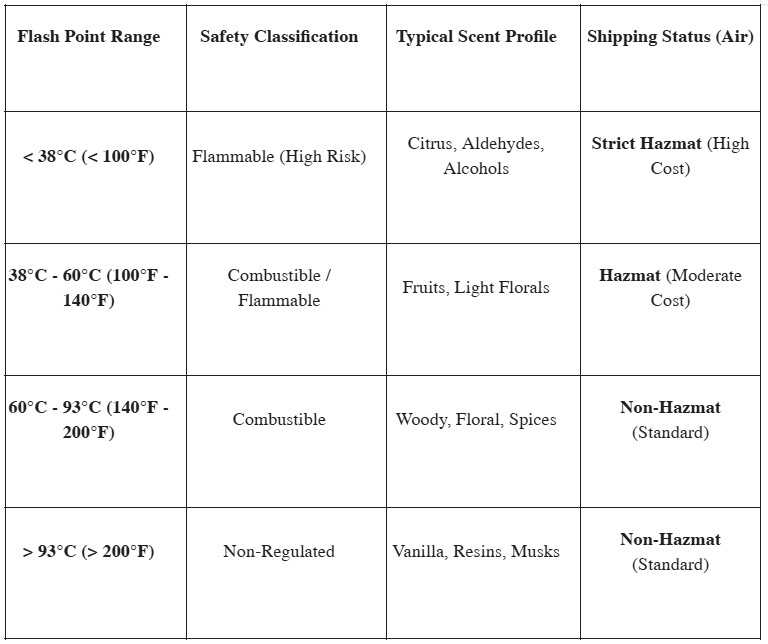
If your business relies on rapid air shipments to meet production deadlines, sourcing oils with a higher flash point can significantly reduce logistical friction. However, it is essential to note that many of the most popular fragrance oils and industry trends, particularly in the “fresh” or “clean” categories, naturally fall into lower flash point ranges due to their citrus content.
Manufacturing Safety: Candles, Soaps, and Diffusers
While logistics is about cost, manufacturing is about physical safety. Different applications have different tolerance levels for fragrance oil flash points.
The Gel Candle Danger Zone
Gel wax is the only medium where flash point is a non-negotiable safety constraint.
- The Risk: Gel wax is melted at higher temperatures and burns hotter than soy or paraffin. Furthermore, the gel structure can trap pockets of gas.
- The Rule: You must use non-polar fragrances with a flash point above 170°F (77°C).
- The Consequence: If a low-flash-point oil is used, these trapped vapour pockets can ignite when the candle burns down, turning the container into a potential pressure bomb.
Cold Process Soap & Seizing
In soap making, a low flash point often correlates with volatile components (like alcohol or certain esters) that can accelerate “trace.” This causes the soap batter to harden instantly in the pot; a process known as seizing. While not a fire hazard, it is a production disaster.
Reed Diffusers
Conversely, for reed diffusers, a lower flash point can sometimes be advantageous. It often indicates lighter molecules that travel up the reeds more easily. However, strict labelling regulations (CLP/GHS) apply if the final product remains flammable. Manufacturers aiming for sustainable fragrance manufacturing often look for biodegradable solvents that maintain efficacy without the extreme volatility of traditional alcohol bases.
Technical Testing: Closed Cup vs. Open Cup
When you review a Technical Data Sheet (TDS), you may see the flash point specified as “TCC” (Tag Closed Cup) or “COC” (Cleveland Open Cup).
- Closed Cup (Standard): The test is conducted in a sealed vessel, simulating a closed drum or bottle. This prevents vapours from escaping, leading to a lower, more conservative temperature reading. This is the global standard for safety regulations and shipping.
- Open Cup: The test surface is exposed to outside air. Vapours can disperse, usually resulting in a higher temperature reading.
Professional manufacturers always rely on Closed Cup data to ensure maximum compliance with strict regulatory bodies like OSHA (Occupational Safety and Health Administration).
Operational Protocols: Handling Low Flash Point Ingredients
There are times when a formulation demands a sparkling Grapefruit top note or a boozy Rum accord, ingredients that naturally possess a low flash point of fragrance oils. In these cases, specific handling protocols must be enforced on the production floor.
1. Grounding and Bonding
Static electricity is the invisible enemy. When transferring flammable liquids from a metal drum to a mixing tank, the friction of the flowing liquid can generate a static charge.
- Protocol: Always attach grounding cables (straps) between the source container and the receiving vessel to equalise the electrical potential and prevent sparks.
2. Ventilation Strategy
Fragrance vapours are heavier than air. They do not rise; they sink and pool along the floor.
- Protocol: Ventilation systems should pull air from the bottom of the room, not just the ceiling. This prevents the accumulation of flammable “vapour lakes” at foot level.
3. Temperature Monitoring
Never heat a fragrance oil directly. When adding scent to a base (wax or lotion), heat the base, remove it from the heat source, and then add the oil.
- Protocol: Ensure the mixing temperature is monitored. While it is safe to add a 140°F flash point oil to 185°F wax (because there is no ignition source), avoiding open flames or heating elements during this step is mandatory.
Conclusion
Understanding fragrance oil flash point data is the mark of a mature manufacturing operation. It allows a business to optimise shipping budgets, design safe production floors, and ensure that final products, whether gel candles or perfumes, perform safely in the hands of the consumer.
Safety is not an obstacle to creativity; it is the framework that makes creativity scalable. By mastering these technical metrics, you ensure that your brand is built on a foundation of reliability.
Frequently Asked Questions
Does adding fragrance oil to wax change the flash point of the candle?
Yes. When you mix a volatile oil into a non-volatile wax, the flash point of the entire mixture changes. However, because the fragrance is diluted (usually 6-10%), the finished candle’s flash point is significantly higher than that of the oil alone. The primary risk remains during the mixing phase, where the raw oil is concentrated.
Can I ship low flash point oils without Hazmat fees?
Only if you ship via Ground (Road/Sea) or in “Limited Quantities” (small bottles). For bulk air cargo, there is no way around the Hazmat classification for oils with a flash point below 60 °C, including fragrance oils.
Why do different suppliers list different flash points for the same scent?
“Lavender” is not a single chemical; it is a compound. One supplier might use a high amount of Linalyl Acetate (Flash Point ~85°C), while another might use more volatile top notes or solvents. The formula dictates the physics. Always check the specific SDS for the batch you are buying.
Is a higher flash point oil safer for skin?
Not necessarily. Flash point measures flammability, not toxicity. A high-flash-point ingredient like Clove Oil can be a severe skin irritant, while a low-flash-point Citrus Oil might be gentle (if not phototoxic). Always refer to the IFRA certificate for skin safety, not the flash point.