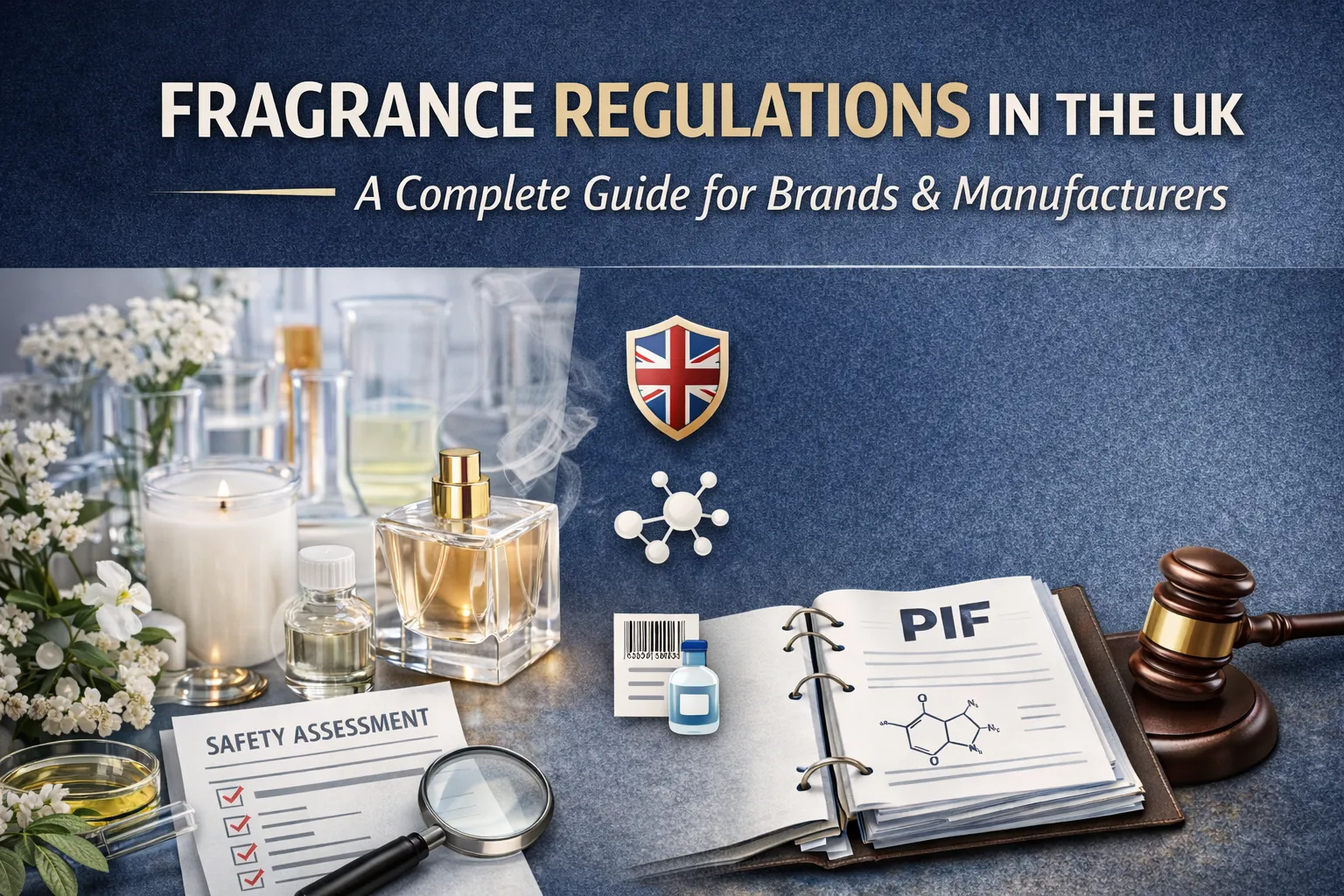
The global fragrance market is growing fast. It was valued at USD 56.60 billion in 2024 and is expected to reach USD 74.76 billion by 2030. This growth is driven by rising demand for unisex fragrances, premium products, and sustainable sourcing. Social media is also shaping how consumers discover and choose fragrances. As the industry expands, brands must keep pace with evolving UK regulations while meeting changing consumer expectations.
Scope and Fragrance Product Categories
Fragrance products in the UK are subject to different regulations depending on their use. Products applied to the skin are regulated as cosmetics. Products used to scent spaces are treated as consumer chemical products. Understanding this difference is key for brands and manufacturers.
Cosmetic Fragrances
Examples include perfume, eau de toilette, body sprays, and deodorants.
- Regulation: Governed by the UK Cosmetics Regulation 2013, based on EU Regulation 1223/2009.
- Safety rules: Products must be safe for human health. A safety assessment is mandatory.
- Documentation: Each product must have a Product Information File and a UK Responsible Person.
- Allergen labelling: Labels must list fragrance allergens if they exceed set limits. New updates expand this list to over 80 allergens.
- Claims: Product claims must be truthful and supported by evidence.
Home Fragrances
Examples include candles, wax melts, reed diffusers, and room sprays.
- Regulation: Covered under the GB Classification, Labelling and Packaging Regulation.
- Labelling requirements: If a product is classified as hazardous, the label must show hazard pictograms, signal words, and safety statements.
- Purpose focus: These rules apply even when products are sold for lifestyle or decorative use.
Aromatherapy Products
- Use-based classification: Products applied to the skin are treated as cosmetics.
- Marketing claims matter: If a product claims to treat or cure a condition, it may be subject to medical regulations.
General Safety Requirements
- Products that do not fall clearly under cosmetic or chemical rules must still comply with the General Product Safety Regulations 2005.
Core Legal Framework for Cosmetic Fragrances (Cosmetics Regulation)
Cosmetic fragrances in Great Britain are regulated under the UK Cosmetics Regulation. This law is the retained and updated version of EU Regulation 1223/2009. It sets clear rules to ensure fragrance products are safe for consumer use.
Any fragrance applied to the skin must follow this framework before it can be sold in the UK.
Key Parts of the UK Cosmetics Regulation
- Legal basis: The main legal framework comes from Schedule 34 of the Product Safety and Metrology Regulations, updated after the UK left the EU.
- UK Responsible Person: Every cosmetic fragrance must have a UK-based Responsible Person. This person ensures compliance, maintains records, and manages product safety.
- Product Information File: A Product Information File must be kept for each product. It includes the formula, safety data, and supporting documents.
- Safety assessment: A Cosmetic Product Safety Report is required. This confirms the fragrance is safe for human health.
- Product notification: All cosmetic fragrances must be registered on the Submit Cosmetic Product Notifications portal before being placed on the market.
- Ingredient restrictions and allergens: Products must comply with strict ingredient requirements. Certain fragrance allergens must be listed on labels if they exceed allowed limits.
- Manufacturing standards: Production must comply with Good Manufacturing Practices as outlined in ISO 22716.
- Northern Ireland rules: Products sold in Northern Ireland must follow the EU Cosmetics Regulation rather than the UK version.
- Labelling timelines: Transitional rules allow time to update the UK Responsible Person’s address on labels. The current deadline is 31 December 2025.
Enforcement
The Office for Product Safety and Standards monitors compliance and can take action if products do not meet regulatory requirements.
Chemical Laws That Affect Fragrances (UK REACH & CLP)
Fragrance products are also affected by chemical safety laws. These rules apply mainly to fragrance ingredients and home fragrance products. Two key regulations apply in Great Britain: UK REACH and the GB CLP Regulation.
UK REACH Regulation
After Brexit, the UK introduced its own version of REACH. This law applies to substances made or imported into Great Britain in quantities of one tonne or more per year.
- Registration requirements: Manufacturers and importers must register substances with the Health and Safety Executive.
- DUIN process: UK businesses importing fragrance ingredients from the EU were required to submit a Downstream User Import Notification. This allows them to use extended registration deadlines, depending on volume and hazard level.
- Restricted substances: Certain high-risk substances are restricted or banned under Annexe XVII. This includes some phthalates, carcinogens, and skin sensitisers used in consumer products.
- Safety Data Sheets: Hazardous fragrance ingredients or products must be supplied with a Safety Data Sheet. This follows the format set out under REACH rules.
GB CLP Regulation
The GB Classification, Labelling and Packaging Regulation governs the classification and labelling of hazardous fragrance products.
- Hazard classification: Sellers must identify risks such as skin irritation, eye damage, or environmental harm.
- Labelling rules
If a product is hazardous, the label must include:- Hazard pictograms
- Signal words such as “Danger” or “Warning”
- Hazard and precautionary statements
- Supplier details
- Small packaging exemptions: Containers under 125 ml may qualify for limited labelling exemptions.
- Poison Centre Notification: Hazardous mixtures for consumer use must be notified to the correct authority. In Great Britain, this is managed through the HSE, while Northern Ireland follows EU procedures.
Industry Standards: IFRA and Voluntary Safe-use Guidance
The International Fragrance Association sets global safety standards for fragrance ingredients. These standards are science-based and voluntary. The latest update is the 51st Amendment, released in 2023. While IFRA is not a law, its standards strongly influence UK cosmetic and chemical regulations.
Many IFRA limits are reflected in the UK Cosmetics Regulation and CLP rules. Following them helps brands protect consumer safety and reduce regulatory risk.
Key Aspects of IFRA Standards in the UK
- Purpose of IFRA: IFRA focuses on the safe use of fragrance materials. Its standards are based on research reviewed by an independent Expert Panel.
- Voluntary but widely followed: IFRA membership is optional. However, members represent most global fragrance production and must follow the standards. In the UK, these rules are treated as industry best practice.
- 51st Amendment requirements: The 51st Amendment introduced stricter limits on certain ingredients. By late 2025, all new and existing products must comply with these updated restrictions.
- Use level calculations: Limits apply to the final product, not just the fragrance blend. Allowed levels vary by product, such as perfumes, lotions, or soaps.
- IFRA product categories: 12 categories. Each category has its own safety limits. Examples include perfumes, rinse-off products, lip products, and non-skin contact items.
Fragrance Allergen labelling and consumer disclosure
In the UK, fragrance allergens must be clearly listed on cosmetic product labels when they exceed set limits. This helps consumers identify ingredients that may cause sensitivity or allergic reactions.
At present, the UK requires labelling of the original list of 24 fragrance allergens. While the EU has expanded this list to more than 80 allergens, the UK has not yet confirmed when the expanded list will apply.
Key UK Fragrance Allergen Labelling Requirements
- Legal basis: Allergen labelling is governed under Schedule 34 of the Product Safety and Metrology Regulations. These rules closely follow the EU Cosmetics Regulation.
- Threshold limits: Allergens must be declared if they exceed:
- 0.001 per cent in leave-on products such as perfumes or lotions
- 0.01 per cent in rinse-off products such as soaps or body washes
- How allergens must be listed: Ingredients must appear on the product label using their official International Nomenclature of Cosmetic Ingredients names.
- Natural ingredients are not exempt: Essential oils and plant extracts must also follow these rules. If they contain regulated allergens above the threshold, they must be disclosed.
Fragrance Labelling, claims and advertising rules in the UK
Key Labelling Requirements
- Ingredients list: All ingredients must be listed using the International Nomenclature of Cosmetic Ingredients. Ingredients appear in descending order by weight. Fragrance blends are shown as “Parfum” or “Aroma.”
- Allergen declaration: Specific fragrance allergens must be listed if they exceed:
- 0.001 per cent in leave-on products
- 0.01 percent in rinse-off products
- Mandatory label information: Labels must include:
- Name and UK address of the Responsible Person
- Country of origin
- Net weight or volume
- Batch or lot number
- Period After Opening symbol
- Product function
- Small packaging rules: If the container is too small, required information can be provided through a leaflet, tag, or outer packaging.
Claims and Advertising Rules
- Truthful and supported claims: All claims, such as “long-lasting” or “hypoallergenic” must be accurate and supported by evidence. Claims must not mislead consumers.
- Use of “free from” claims: These claims are allowed only when they help consumers make informed choices. They should not be used to criticise approved ingredients or to highlight ingredients that are already absent.
- Regulatory oversight: Guidance from the Cosmetic, Toiletry and Perfumery Association helps brands stay compliant. The Advertising Standards Authority monitors claims and takes action when rules are broken.
About LuxeoLabs: Performance-Driven Fragrance Solutions, Responsibly Made
LuxeoLabs creates high-performance fragrance oils for brands worldwide. Our solutions are used in fine fragrance, personal care, air care, and fabric care applications. Every fragrance is designed to deliver both strong technical performance and a refined sensory experience.
All formulations are developed in-house. Each project is tailored to your brief and aligned with current regulatory requirements and market trends.
Our Core Focus Areas
- Green chemistry: We develop low-VOC, solvent-free, and biodegradable fragrance options to reduce environmental impact.
- Clean manufacturing: Our facilities operate on solar power and follow zero-waste production protocols.
- Traceable, cruelty-free sourcing: We ensure ethical sourcing with full transparency throughout the supply chain.
- Regulatory and quality certifications: Our processes comply with ISO 9001, ISO 22716, and IFRA safety standards.
Commitment to Sustainable Innovation
We allocate 5 per cent of our annual research and development budget to green chemistry. This includes reducing VOCs and developing biodegradable fragrance materials. We also work closely with global sustainability bodies such as IFRA and Ecocert to support responsible product development.
As part of our long-term vision, LuxeoLabs is launching a Clean Air Fragrance Initiative. This program focuses on reducing the airborne impact of scented products in indoor environments while maintaining performance and fragrance quality.
Frequently Asked Questions
Which fragrance regulations apply in the UK?
UK fragrances are regulated under the UK Cosmetics Regulation for on-skin products and under UK REACH and GB CLP for home and air care products.
Do all fragrance products need a UK Responsible Person?
Only cosmetic fragrance products require a UK Responsible Person. Home fragrances do not, but they must still meet chemical safety rules.
Are IFRA standards mandatory in the UK?
IFRA standards are not the law, but they are widely followed. Most UK brands treat them as essential for safe and compliant formulations.
Do natural fragrances need allergen labelling?
Yes. Essential oils and natural extracts must list allergens if they exceed the label’s allowed limits.
What happens if a fragrance product is non-compliant?
Non-compliant products may be removed from sale, recalled, or fined by regulators such as the Office for Product Safety and Standards.