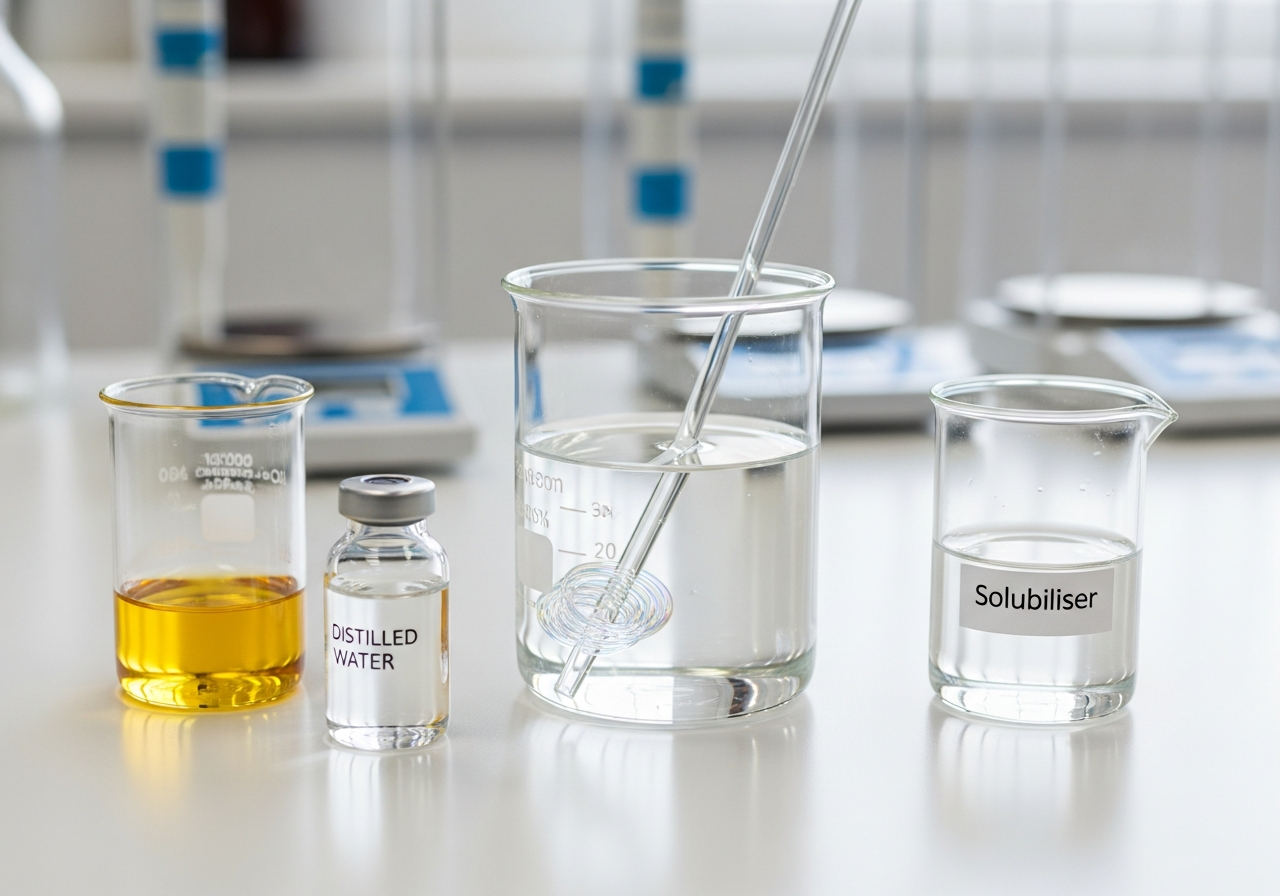
Water and oil never mix; that is a basic law of nature. The reason why this happens is that water is a polar molecule, meaning it has a positive charge at one end and then a negative charge on the other end. On the other hand, oil is a nonpolar molecule, meaning the charges are balanced.
The same thing happens with fragrance oil and water. Fragrance oil does not dissolve in water. This becomes the most challenging part for formulators trying to make a crystal-clear body mist, room spray, hydrosol, or water-based cosmetic with a strong scent.
There is one solution: to solubilise it. But how does that work? Well, in this article, we will explain the science, the best methods, tested recipes, stability and safety considerations, and troubleshooting—everything you need to know if you wonder how to dissolve fragrance oil in water.
Fragrance oils are a mixture of lipophilic, or oil-loving, molecules. Since water is polar and oils are nonpolar, they do not mix or dissolve in each other. If you ask how to dissolve fragrance oil in water, the answer is to:
The selected approach will have tradeoffs in scent throw, clarity, skin feel, regulatory compliance, and price.
Since fragrance oils are hydrophobic, they repel water. Without proper solubilisation, the formula separates, becomes cloudy, and loses scent uniformity over time.
If formulators are looking to create a clear, stable, and professional-grade formulation, they should use the right solubilisation method and ratio. According to global formulation standards, the solubiliser-to-fragrance ratio ranges from 1:1 to 5:1, which depends on the solubiliser type and fragrance composition.
Let us understand the step-by-step guide that can answer all your doubts about how to dilute fragrance oil and mix it with water:
A solubiliser is a surfactant that allows oil-based ingredients to be seamlessly blended into water. It forms microscopic "micelles" that trap oil molecules inside, dispersing them evenly throughout the water, creating a clear or translucent appearance.
Some of the commonly used solubilisers are:
The correct balance is important if you are wondering how to dissolve fragrance oil in water. It is best to start small and then scale up as you get more clarity. Here are some ratios and the expected clarity.
Note: Certain fragrance compounds like musk or vanilla may require a higher solubiliser ratio because of the heavier molecular structure.
This is an important step that must not be missed, especially by beginners:
Step 1: Measure the solubiliser and fragrance oils precisely.
Step 3: Mix both slowly in the beaker until the mixture turns clear and uniform.
Step 4: It is also necessary to allow the mix to rest for a couple of minutes to ensure the complete encapsulation of oil molecules.
Once the premix containing solubiliser-fragrance is ready, the next steps involve:
Step 1: Slowly add it to distilled or deionised water while stirring gently.
Step 2: Continue mixing until the solution appears clear or slightly translucent.
Step 3: If cloudiness remains, add small increments of solubiliser and stir again.
Since solubilised systems are water-based, they are quite prone to microbial growth. Hence, it becomes necessary to maintain the pH balance between 5.0 and 6.5 and add a broad-spectrum preservative (like phenoxyethanol + ethylhexylglycerin or sodium benzoate + potassium sorbate) according to supplier guidelines.
Successful solubilisation is when the formulation remains stable, clear, and functional. To do so, here are some of the things that can be done:
For a lighter texture and faster dry-down, small amounts of co-solvents can also be used. Some examples are:
When fragrance oil is dissolved in water with solubilising, mistakes can happen. The process may look simple, but minor errors, from incorrect ratios to incompatible solubilisers, can cause cloudiness, separation, or even microbial instability.
Here are the mistakes that must be avoided:
For many, the question of how to dissolve fragrance oil in water remains a mystery. However, it is all about correct science and precision. By utilising the right solubilisers, mixing the fragrance oil and water in the ideal ratios, and following correct protocols, formulators can achieve clear, stable, and beautifully scented products. So, whether it is about developing perfumes, creating mists, or producing cosmetics, mastering the art of solubilisation will allow for consistent performance, an elevated sensory experience, and better shelf life. Proper solubilisation techniques can help solve the mystery of how to dilute fragrance oil effortlessly.
The best method is to premix fragrance oil with a solubiliser like Polysorbate 20 or PEG-40 hydrogenated castor oil before adding it to water. Stir gently until fully blended.
Cloudiness can occur if the solubiliser ratio is too low or if the fragrance oil contains heavy or complex aromatic molecules. Try adjusting the solubiliser amount or using a co-solvent.
Yes, ethanol or isopropyl alcohol can help solubilise certain fragrance oils. However, alcohol-based solutions can dry quickly and may not suit all formulations, like facial mists or skincare sprays.
Always mix at room temperature (20–25°C). Higher temperatures may degrade the fragrance compounds or affect the solubiliser performance.
Yes, but essential oils often require stronger solubilisers or higher ratios due to their complex molecular weight and polarity. It is also necessary to shake the mixture before use so that the molecules disperse equally.