
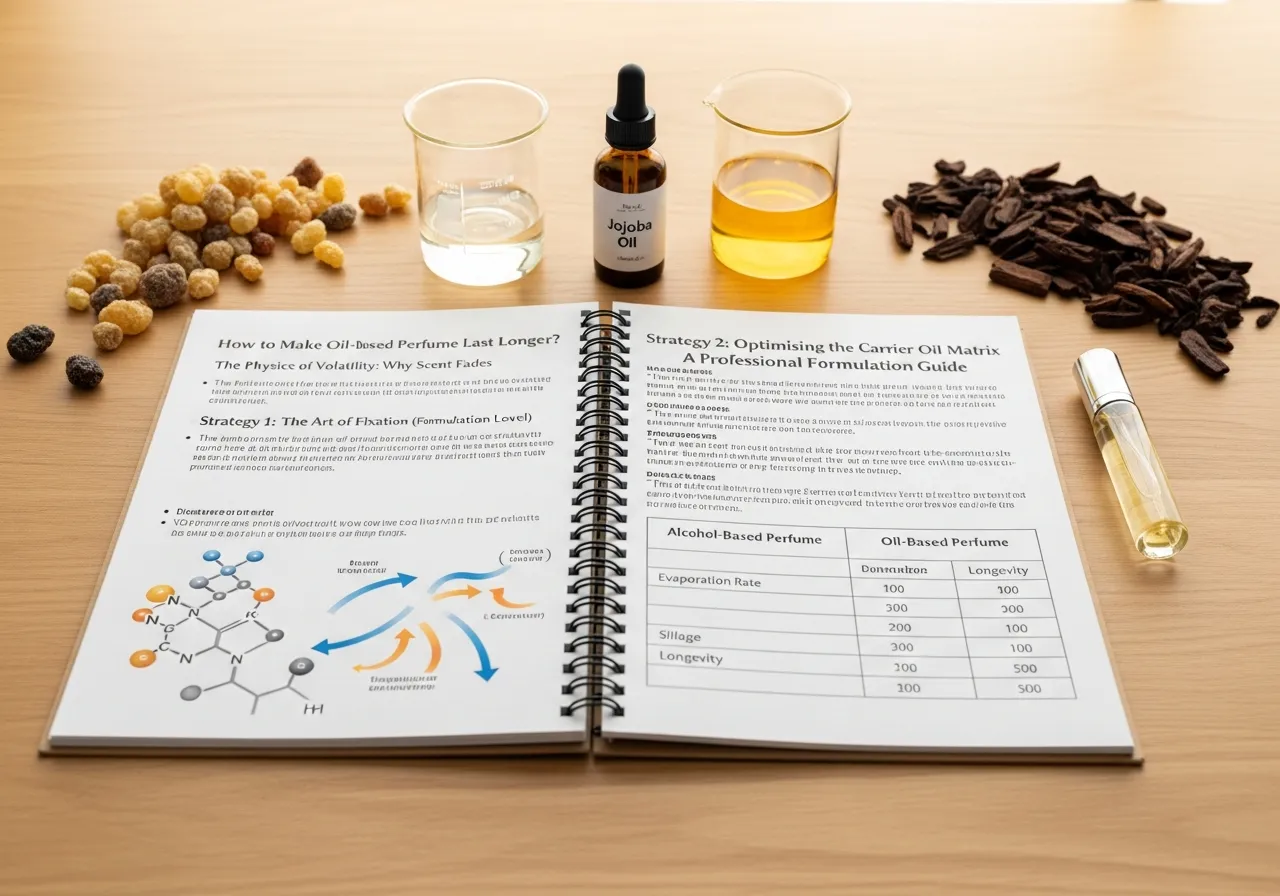
In the fragrance industry, longevity is the currency of customer satisfaction. While the initial top notes might trigger the sale, it is the lasting power of the scent that drives brand loyalty. For product developers and perfumers, the challenge is constant: creating a fragrance that endures without becoming cloying.
Unlike alcohol-based sprays, which rely on rapid evaporation to project scent, oil-based perfumes (such as attars, roll-ons, and solid perfumes) work differently. They are intimate, sticking close to the skin. However, a common consumer complaint is that these scents can sometimes feel “flat” or fade too quickly if not engineered correctly.
Solving this requires a deep understanding of molecular physics, carrier oil compatibility, and fixation techniques. This guide explores technical strategies to make oil-based perfume last longer, transforming fleeting aromas into enduring olfactory signatures.
The Physics of Volatility: Why Scent Fades
To understand longevity, we must first understand volatility. Every scent molecule has a specific vapour pressure, the speed at which it evaporates from the skin.
- High Volatility (Top Notes): Citrus, light herbs. These evaporate in minutes.
- Low Volatility (Base Notes): Woods, Resins, Musks. These linger for hours.
In an alcohol base, the ethanol acts as a vehicle, lifting these molecules into the air quickly. In an oil base, the carrier oil (like Jojoba or Fractionated Coconut Oil) “weighs down” the molecules. This creates a paradox: oil-based perfumes naturally persist longer on the skin because they don’t evaporate as fast, but they project less. The challenge is to maintain that presence over time.
Strategy 1: The Art of Fixation (Formulation Level)
For a manufacturer, the answer to how to make oil-based perfume last longer begins in the lab, not on the customer’s wrist. It starts with “fixatives.”
A fixative is a raw material with a high molecular weight that acts as an anchor. It physically traps lighter, more volatile molecules, slowing down their evaporation rate.
Natural vs. Synthetic Fixatives
- Resinoids: Materials like Benzoin, Labdanum, and Myrrh are sticky, heavy substances that form a microscopic film on the skin, holding the scent in place.
- Macrocyclic Musks: Synthetic musks (like Ethylene Brassylate) are crucial in modern perfumery. They are large molecules that not only smell clean but also significantly extend the lifespan of floral and fresh notes.
If you are sourcing ingredients for a new line, prioritising high-quality base notes is essential. Brands that invest in global sourcing and quality control for their heavy base notes invariably produce perfumes with superior substantivity (sticking power).
Strategy 2: Optimising the Carrier Oil Matrix
Not all carrier oils are created equal. The choice of the solvent (the oil that carries the fragrance concentrate) plays a massive role in how the scent performs.
- Jojoba Oil: Mimics human sebum. It absorbs into the skin quickly. While good for moisturising, it can sometimes “eat” the scent if it absorbs too fast.
- Fractionated Coconut Oil (MCT): A preferred choice for many commercial roll-ons. It is light, shelf-stable, and sits on the surface slightly longer than Jojoba, allowing the scent to breathe.
- Dipropylene Glycol (DPG): While synthetic, this is often used in oil-based formulations to bind the fragrance molecules and retard evaporation.
When you see a product where the oil-based perfumes last longer, it is often because the formulator has balanced the absorption rate of the carrier oil with the evaporation rate of the fragrance oil.
Strategy 3: Maceration (The Ageing Process)
Patience is a chemical necessity. When you mix fragrance concentrate with a carrier oil, the mixture is initially chaotic. The molecules haven’t bonded.
Maceration is the process of letting the mixture sit in a cool, dark place for a period ranging from 2 weeks to 3 months. During this time, the carrier oil molecules and fragrance molecules form a more stable matrix. A well-macerated perfume smells smoother and, crucially, lasts longer because the volatile notes are better integrated into the heavy oil base.
Strategy 4: Skin Chemistry and Application (Consumer Education)
While formulation is key, educating your customer on application is equally vital. You can engineer the perfect scent, but dry skin can ruin it.
The Moisture Barrier
Fragrance needs moisture to anchor itself. Dry skin acts like a wick, absorbing the oils instantly and leaving nothing on the surface to emit scent.
- The Fix: Advise customers to apply an unscented moisturiser or a primer before the perfume oil. This creates a lipid barrier that holds the fragrance.
Pulse Points and Heat
Oil-based perfumes are heat-activated. They need the warmth of the blood to volatilise the scent.
- Target Areas: Wrists, behind the ears, the dip of the clavicle, and behind the knees.
For brands looking to stay ahead of the curve, understanding these consumer behaviours is key. In our analysis of the most popular fragrance oils and industry trends, we see a rising demand for “fragrance primers”, products specifically designed to prep the skin for oil-based scents.
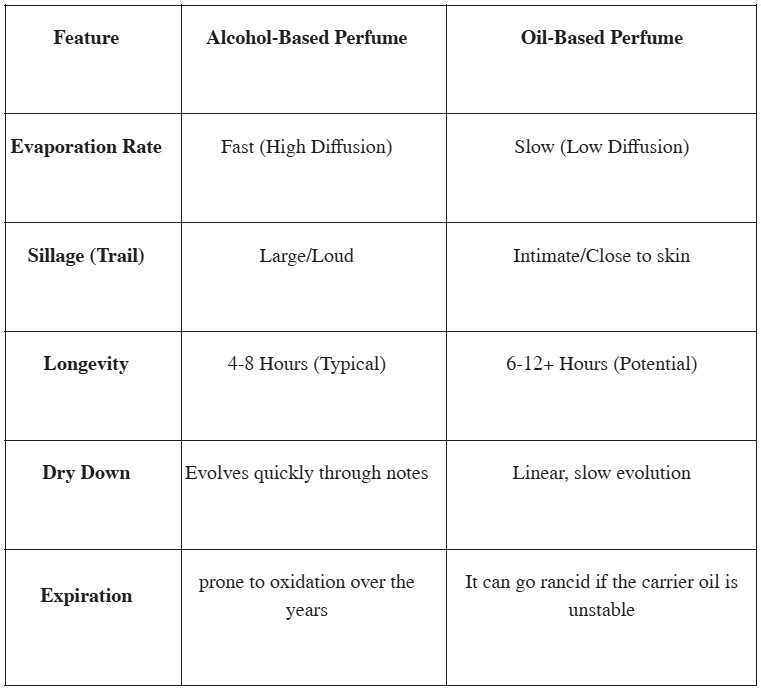
A Comparative Look: Alcohol vs. Oil Longevity
To help you position your product in the market, here is a comparison of how different bases affect performance.
The Role of Concentration
One of the most direct ways to address how to make oil-based perfume last longer is simply increasing the concentration.
- Eau de Parfum (Alcohol): Typically 15-20% fragrance oil.
- Perfume Oil / Attar: Can be 30% to even 100% fragrance oil.
Because oils are less aggressive than alcohol, you can formulate at much higher concentrations without risking the “burning” sensation on the nose or skin. A higher concentration means more molecules per square inch of skin, leading to a naturally longer-lasting experience.
However, high concentration requires careful safety checks. Always ensure your formulation complies with IFRA standards to avoid skin sensitisation. You can check specific ingredient limits on the International Fragrance Association (IFRA) website.
Storage: The Silent Killer of Longevity
Even the most robustly formulated oil will fail if stored improperly.
- Heat: Breaks down the chemical bonds of the fixatives.
- Light: UV rays degrade complex molecules, especially naturals like Bergamot or Vanilla.
- Oxygen: Causes the carrier oil to go rancid (oxidize), which ruins the scent profile.
Manufacturers must use UV-coated bottles or opaque containers. If you are interested in the complete lifecycle of a fragrance product, from raw material to shelf stability, our guide on sustainable fragrance manufacturing covers best practices for packaging and preservation.
Conclusion
Longevity is not magic; it is chemistry. Whether you are a hobbyist perfumer or a manufacturer, the secret to making oil-based perfumes last longer lies in the balance of the blend. It requires a heavy hand with base note fixatives, a high-quality carrier oil, and the patience to allow for proper maceration.
By focusing on the structural integrity of the fragrance, building it from the bottom up, you ensure that the scent remains a loyal companion to the wearer throughout the day, rather than a fleeting memory.
Frequently Asked Questions
Does Vaseline help oil-based perfumes last longer?
Yes. Applying a thin layer of petroleum jelly (Vaseline) to pulse points before perfume application creates an occlusive barrier. This prevents the fragrance oil from sinking deep into the pores, keeping it on the surface where it can be smelled for longer.
Why does my oil perfume smell strong at first but fade in an hour?
This usually indicates a lack of “heart” and “base” notes. The perfume is likely composed mainly of top notes (citrus/fruity). To fix this, the formula needs more fixatives or heavy molecules like woods, ambers, or musks to anchor the lighter scents.
Does maceration really work for oil perfumes?
Absolutely. In fact, it is more critical for oils than alcohol. Alcohol is a powerful solvent that quickly breaks down ingredients. Carrier oils are gentler, so they need more time (weeks) to fully “marry” with the fragrance concentrate.
Which carrier oil is best for longevity?
Fractionated Coconut Oil (MCT) and Jojoba Oil are the industry standards. MCT is particularly good for longevity because it is extremely stable and resistant to oxidation, ensuring the perfume doesn’t turn rancid, effectively preserving the scent’s integrity over time.