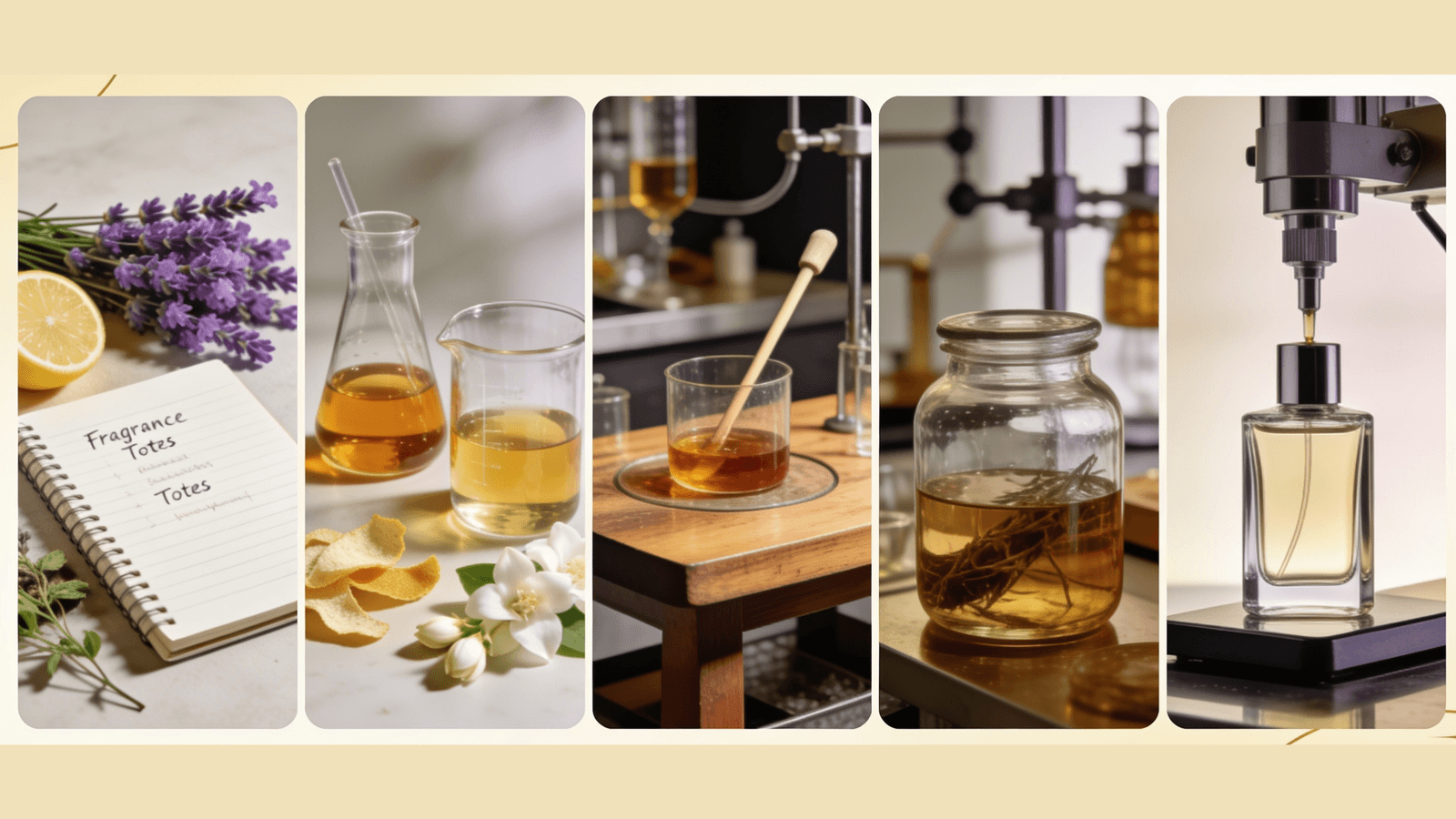
A finished perfume feels effortless, a single spray, a signature scent, an instant impression. Behind that simplicity lies a months-long industrial and creative process involving raw material sourcing, formulation, stability testing, and regulatory compliance. Whether you’re a B2B buyer evaluating suppliers, a startup founder planning your first fragrance line, or a distributor seeking reliable manufacturing partners, understanding how perfume moves from creative brief to final bottle helps you control quality, plan timelines, and assess production capabilities.
Luxeolabs operates facilities in Sharjah (UAE), Grasse (France), and Mumbai (India) with ISO 9001, GMP ISO 22716, and IFRA compliance. Our infrastructure supports fine fragrance, personal care, home care, and fabric care applications with capacity up to three tons per day. In this guide, we’ll walk through the 10 stages of perfume manufacturing, from fragrance brief to batch traceability, and explain why every stage matters for scalability, consistency, and market readiness.
10 Stages of the Perfume Manufacturing Process
These stages apply across fine fragrance, personal care, home care, and fabric care applications. Timelines vary: fine fragrance projects typically take 8–18 months from brief to launch, while functional fragrance for detergents or air care can move faster when using established formulas. Luxeolabs’ fragrance solutions cover all categories with the same quality standards.
1. Fragrance Brief & Creative Direction
Every perfume begins with a brief. The client specifies target market (luxury, mass-market, niche), price point, fragrance family (floral, woody, oriental, fresh), reference perfumes, and maximum formula cost per kilogram. For B2B projects, the brief also includes technical requirements: compatibility with packaging materials, stability in hot climates, allergen restrictions, and regulatory constraints (EU CPNP, US FDA, GCC ESMA).
Large fragrance houses often run competitive submissions, multiple perfumers pitch formulas, and the client selects one. In private-label or collaborative models, the perfumer works directly with the client through revision rounds. Luxeolabs’ in-house perfumers, Flora Gourdon, Ankush Chinchane, and Sara Chabokrow, translate briefs into olfactory direction, balancing creative vision with cost and compliance.
Table 1: Fragrance Brief Components
| Component | Example | Purpose |
| Target Audience | Women 25–40, premium segment | Defines scent profile and packaging expectations |
| Fragrance Family | Woody oriental with amber base | Sets olfactory direction and ingredient palette |
| Cost Constraint | ≤$15/kg formula cost | Determines raw material selection and complexity |
| Technical Requirements | IFRA-compliant, stable at 45°C | Ensures regulatory adherence and shelf life |
2. Raw Material Sourcing & Ingredient Selection
Perfume formulas blend naturals (essential oils, absolutes, resins) with synthetics (aroma chemicals). Naturals deliver complexity and depth but vary by harvest; synthetics provide consistency, cost control, and access to scents that don’t exist in nature (e.g., fresh linen, ocean breeze).
Extraction methods determine quality and cost. Steam distillation works for lavender, eucalyptus, and peppermint, heat-stable materials that release oils under steam. Cold-press extracts citrus peels (lemon, bergamot) without heat, preserving bright top notes. Solvent extraction captures delicate florals like jasmine and tuberose that can’t withstand steam; the result is an absolute with richer, deeper character. CO₂ extraction uses supercritical carbon dioxide to pull scent molecules at low temperature, ideal for spices and delicate botanicals.
Luxeolabs’ Grasse lab sources premium raw materials and maintains approved ingredient libraries. IFRA (International Fragrance Association) sets allergen limits for materials like oakmoss, citral, and linalool; formulas must comply before production. Sustainable sourcing reduces pressure on rare naturals, sandalwood, oud, and rose, by blending naturals with high-quality synthetics that replicate key facets.
Table 2: Extraction Methods Comparison
| Method | Typical Materials | Pros | Cons |
| Steam Distillation | Lavender, eucalyptus, rosemary | Cost-effective, scalable | Heat can alter delicate notes |
| Cold-Press | Citrus peels (lemon, bergamot) | Preserves bright, fresh character | Short shelf life, oxidation risk |
| Solvent Extraction | Jasmine, tuberose, vanilla | Captures full floral depth | Higher cost, residual solvents |
| CO₂ Extraction | Spices, delicate florals | Low-temperature, pure extract | Expensive equipment, limited scale |
3. Fragrance Formulation & Accord Building
A perfumer’s organ, a workspace with 3,000+ raw materials, is where formulas take shape. Perfumers build accords (sub-blends like rose accord, woody base) and layer them into the top-heart-base pyramid. Top notes (citrus, herbs) evaporate in 15–30 minutes and create first impressions. Heart notes (florals, spices) emerge after 30 minutes and define the fragrance’s character. Base notes (woods, musks, resins) last 4–8 hours and anchor the scent.
A typical formula contains 50–150 ingredients. The perfumer balances scent profile, longevity, stability, and cost. A luxury EdP might use 120 ingredients with rare naturals; a mass-market body mist might use 40 ingredients with cost-effective synthetics. Luxeolabs uses AI-supported design and analytical labs to refine formulations, predictive models suggest ingredient substitutions that maintain scent profile while reducing cost or improving stability.
Table 3: Fragrance Pyramid Structure
| Layer | Volatility | Typical Materials | Function | Lasting Time |
| Top Notes | High | Citrus, herbs, aldehydes | First impression, freshness | 15–30 minutes |
| Heart Notes | Medium | Florals, spices, fruits | Core character, complexity | 2–4 hours |
| Base Notes | Low | Woods, musks, resins, amber | Depth, longevity, fixation | 4–8 hours |
4. Trial Blending & Sample Evaluation
Laboratory-scale blending uses precision scales (0.01 g accuracy) to mix trial batches, typically 100–500 ml. The perfumer evaluates olfactory accuracy (does it match the brief?), dry-down performance (how does it evolve on skin?), skin compatibility (any irritation?), and projection (how far does the scent travel?).
Luxeolabs delivers tailored samples in three business days and supports 2–3 revision rounds. Evaluators (trained assessors) translate client feedback into technical guidance: more freshness might mean increasing citrus top notes by 5%; longer lasting might mean boosting base notes or switching to slower-evaporating musks. This stage is iterative, fine fragrance projects often run 8–12 revision cycles; functional fragrance for detergents might finalize in 2–3 cycles.
5. Stability & Compatibility Testing
Once the formula is approved, it enters stability testing. Accelerated aging simulates months of shelf life in weeks: samples sit at 45°C and 75% humidity for 28 days. Freeze-thaw cycles test resilience to temperature swings during shipping. Light exposure tests check for discolouration or scent degradation under UV. Packaging compatibility ensures the fragrance doesn’t react with glass, pumps, or caps, some materials leach plasticizers or corrode metal crimps.
GC/MS (gas chromatography-mass spectrometry) analysis verifies purity and allergen content. Luxeolabs follows ISO 22716 and IFRA standards, documenting every test result for regulatory submissions. If a formula fails stability, scent shifts, colour darkens, sediment forms, the perfumer reformulates with more stable materials or adjusts the base structure.
Table 4: Stability Testing Protocols
| Test Type | Conditions | Duration | Pass Criteria |
| Accelerated Aging | 45°C, 75% RH | 28 days | No scent shift, colour stable |
| Freeze-Thaw | –10°C to 40°C cycles | 5 cycles | No separation, no cloudiness |
| Light Exposure | UV lamp, 6,000 lux | 14 days | No discolouration, scent intact |
| Packaging Compatibility | Contact with glass, pumps, caps | 90 days | No leaching, no corrosion |
6. Bulk Fragrance Production & Maceration
Approved formulas move to bulk blending in stainless steel tanks. Luxeolabs’ capacity reaches up to three tons per day, supporting both pilot batches (500–1,000 units) and high-volume orders (10,000+ units). Ingredients are weighed, added in sequence (base notes first, top notes last), and mixed under controlled temperature (~15°C) to prevent evaporation.
Maceration is the resting period, 2–8 weeks, that allows ingredients to integrate. Molecules bond, sharp edges soften, and sediments precipitate. Without maceration, the fragrance smells disjointed; after maceration, it smells cohesive. Fine fragrances macerate longer (6–8 weeks) to develop depth; functional fragrances for detergents macerate shorter (2–3 weeks) because longevity matters less than immediate impact. Climate-controlled environments maintain consistent temperature and humidity, preventing premature evaporation or condensation.
7. Alcohol Mixing & Final Filtration
After maceration, the fragrance concentrate is diluted with cosmetic-grade alcohol (perfumer’s alcohol, 75–96% ethanol) to achieve the desired concentration. Parfum (20–30% oil) lasts 8+ hours and costs more. Eau de Parfum (15–20% oil) lasts 6–8 hours and balances performance with price. Eau de Toilette (5–15% oil) lasts 3–4 hours and suits everyday wear. Eau de Cologne (2–4% oil) lasts 1–2 hours and offers light, refreshing scents.
Multi-stage filtration removes waxes, sediments, and impurities. Plate or cartridge systems (1–5 micron filters) ensure visual clarity, no cloudiness, no particles. Luxeolabs uses climate-controlled environments to maintain fragrance stability during filtration; temperature swings can cause re-precipitation of waxes or resins.
Table 5: Fragrance Concentration Levels
| Type | Oil % | Lasting Time | Typical Use Case | Price Range |
| Parfum | 20–30% | 8+ hours | Luxury, evening wear | High |
| Eau de Parfum | 15–20% | 6–8 hours | Daily luxury, signature scent | Medium-high |
| Eau de Toilette | 5–15% | 3–4 hours | Everyday, office-friendly | Medium |
| Eau de Cologne | 2–4% | 1–2 hours | Light, refreshing, post-shower | Low-medium |
8. Bottle Preparation & Component Inspection
Packaging preparation runs parallel to fragrance production. Glass bottles, atomizers, pumps, caps, and labels arrive from suppliers and undergo inspection for defects, dimensional accuracy, and compatibility. Bottles are checked for cracks, chips, or uneven walls. Pumps are tested for spray pattern and dosage consistency. Caps are checked for fit and seal integrity.
Luxeolabs offers stock bottles (MOQ 500–1,000 units, 15-day lead time) and custom molds (MOQ 5,000+ units, 30–45 days, mold cost $800–3,000). Stock bottles suit startups and private-label projects; custom molds suit established brands building unique packaging. Reliable factories reject substandard materials before filling, one defective batch can ruin thousands of units.
9. Automated Filling, Crimping & Labeling
Filling lines vary by scale. Automated lines (large volumes, 3,000+ units/day) use conveyor belts, volumetric pumps, and robotic crimpers. Semi-automated lines (private label, 500–1,500 units/day) combine manual bottle placement with automated filling and crimping. Manual lines (small-batch, premium, <500 units/day) suit artisanal projects where hand-finishing adds value.
The process: bottles move through filling stations (volumetric pumps dispense exact amounts), crimping stations (pumps are attached and sealed), spray testing (random samples are tested for function), labeling (automated machines apply labels, manual QC checks alignment), and leakage testing (bottles are inverted or pressurised to check seals). Luxeolabs’ high-efficiency filling lines ensure consistent volume (±0.5 ml tolerance) and minimise waste.
10. Quality Control, Batch Traceability & Regulatory Documentation
Final QA checks every unit: label alignment, leakage, spray function, visual defects. Inspectors pull random samples from each batch and test spray pattern, dosage, and scent accuracy. Defective units are removed; pass rates for reliable factories exceed 98%.
Batch traceability links every bottle to production records. Batch numbers encode production date, formula version, and raw material lot numbers. Retained samples (stored for 3–5 years) allow factories to investigate complaints or regulatory queries. Inspection records document every QA checkpoint.
Regulatory documentation includes IFRA certificates (allergen compliance), SDS/MSDS (safety data sheets), ingredient declarations (INCI names for cosmetics), EU CPNP notification (Cosmetic Products Notification Portal), US FDA compliance (labeling, ingredient safety), and GCC ESMA/SFDA certification (Emirates Authority for Standardization and Metrology, Saudi Food and Drug Authority). Luxeolabs provides full documentation for customs clearance and product registration.
Table 6: Regulatory Compliance by Market
| Market | Required Compliance | Label Requirements | Typical Lead Time |
| EU/UK | CPNP notification, IFRA, CLP | INCI list, allergen warnings, batch code | 4–6 weeks |
| USA | FDA cosmetic registration (voluntary), IFRA | Ingredient list, net weight, distributor address | 2–4 weeks |
| Middle East (UAE/Saudi) | ESMA/SFDA certification, IFRA | Arabic labels, halal certification (optional) | 6–8 weeks |
| Southeast Asia | ASEAN Cosmetic Directive, IFRA | Local language labels, importer details | 4–6 weeks |
| China | NMPA registration, animal testing (changing) | Chinese labels, NMPA approval number | 12–18 months |
Why Production Capacity & Scalability Matter
Flexible MOQs (minimum order quantities) suit different business stages. Pilot batches (500–1,000 units) let startups test market response without overcommitting capital. Medium-scale (3,000–5,000 units) suits growing brands expanding distribution. High-volume (10,000+ units) suits distributors and established brands with predictable demand.
Luxeolabs supports both small-batch and large-scale production with the same quality standards. Production schedules are organised by project scope: pilot batches run weekly, medium-scale orders run bi-weekly, high-volume orders run monthly with advance planning. Capacity planning ensures on-time delivery, factories with insufficient capacity miss deadlines or compromise quality by rushing production.
In-House Perfumery vs. Outsourced Fragrance Development
In-house perfumers (Luxeolabs model) deliver faster revision turnaround, 3–5 days from feedback to new sample. The perfumer sits in the same facility as production, so they can adjust formulas, test stability, and coordinate with QA without delays. Outsourced perfumery (common in contract manufacturing) adds 10–15 days per revision because samples travel between the perfumer’s lab and the factory.
Luxeolabs’ in-house perfumers, Flora Gourdon (fine fragrance, air care, candles), Ankush Chinchane (personal care, home care, African and Middle Eastern markets), and Sara Chabokrow (fine fragrance, body care, diffusers), bring decades of experience across fine fragrance, personal care, home care, and fabric care. In-house teams reduce lead times, improve project coordination, and allow real-time adjustments during production.
How Luxeolabs Supports B2B Fragrance Manufacturing
Luxeolabs offers end-to-end capabilities: custom fragrance development, private label, OEM/ODM, bulk production, and regulatory support. Our global facilities, Sharjah (UAE), Grasse (France), and Mumbai (India), combine French perfumery heritage with modern infrastructure. Certifications include ISO 9001 (quality management), GMP ISO 22716 (cosmetic manufacturing), and IFRA compliance (allergen safety).
Fast turnaround: samples in three days, final products in seven. Flexible MOQs: pilot batches from 500 units, scalable to 10,000+ units. Production capacity: up to three tons per day. Full documentation: IFRA certificates, SDS/MSDS, INCI declarations, CPNP/FDA/ESMA compliance, batch traceability. Whether you’re launching a niche perfume line, scaling a personal care brand, or sourcing fragrance oils for home care products, contact us to discuss your project.
Conclusion
Modern perfume manufacturing blends creativity, the perfumer’s artistry in balancing 50–150 ingredients, with precision: chemistry, quality control, and regulatory compliance. Understanding the 10 stages helps B2B buyers evaluate suppliers, control quality, and plan timelines. Luxeolabs combines French perfumery heritage (Grasse) with modern infrastructure (Sharjah, Mumbai) to deliver high-quality, scalable fragrance oils for fine fragrance, personal care, home care, and fabric care.
Partner with Luxeolabs for custom fragrance development and reliable manufacturing. Contact us to discuss your project.
FAQ
How long does perfume manufacturing take?
Fine fragrance projects typically take 8–18 months from brief to launch, including formulation (2–4 months), stability testing (3–6 months), and production (2–3 months). Functional fragrance for detergents or air care can move faster, 4–8 months, when using established formulas. Luxeolabs delivers samples in three days to accelerate early-stage development.
What is maceration and why does it matter?
Maceration is the resting period (2–8 weeks) after bulk blending. Ingredients integrate, molecules bond, and sediments precipitate. Without maceration, the fragrance smells disjointed; after maceration, it smells cohesive. Fine fragrances macerate longer (6–8 weeks) to develop depth; functional fragrances macerate shorter (2–3 weeks) because immediate impact matters more than long-term evolution.
What certifications should a perfume factory have?
Look for ISO 9001 (quality management), GMP ISO 22716 (cosmetic manufacturing), and IFRA compliance (allergen safety). For export, check market-specific certifications: EU CPNP, US FDA registration, GCC ESMA/SFDA. Luxeolabs holds all major certifications and provides full documentation for customs clearance.
What is the difference between EdP and EdT?
Eau de Parfum (EdP) contains 15–20% fragrance oil and lasts 6–8 hours. Eau de Toilette (EdT) contains 5–15% oil and lasts 3–4 hours. EdP costs more but offers stronger projection and longevity; EdT suits everyday wear and lighter budgets.
What is the minimum order quantity for custom perfume?
MOQs vary by project type. Pilot batches start at 500–1,000 units for startups testing market response. Medium-scale orders (3,000–5,000 units) suit growing brands. High-volume orders (10,000+ units) suit distributors and established brands. Luxeolabs supports flexible MOQs across all scales.
How do you ensure fragrance consistency across batches?
Batch traceability links every bottle to production records: batch numbers encode production date, formula version, and raw material lot numbers. Retained samples (stored for 3–5 years) allow factories to compare new batches against reference standards. GC/MS analysis verifies that each batch matches the approved formula within ±2% tolerance.
What regulatory documentation is required for export?
Documentation varies by market. EU/UK requires CPNP notification, IFRA certificates, and CLP-compliant labels. USA requires ingredient lists and net weight declarations (FDA registration is voluntary). Middle East (UAE/Saudi) requires ESMA/SFDA certification and Arabic labels. Luxeolabs provides full documentation for all major markets.