Choosing between private label fragrances and custom fragrance development can shape how your brand is perceived in the market. Each approach offers distinct benefits, costs, and timelines. Private-label fragrances help brands launch quickly with lower investment, while custom fragrance development enables deeper storytelling through custom scents. This blog breaks down the fragrance manufacturing process and explains how fragrance oils and aroma chemicals are used in both models. You will learn the pros and cons of private-label perfume and custom perfume options, how scalability works, and which path best suits your brand goals. The guide also explains why many fragrance oil brands partner with Luxeo Labs.
Understanding the Fragrance Manufacturing Process
The fragrance manufacturing process blends creativity with chemistry. It turns raw ingredients into finished fragrance oils used in perfumes, personal care, and home products. Both fragrance oil suppliers and aroma chemicals suppliers follow a structured process to ensure quality, safety, and consistency.
At a high level, fragrance manufacturing involves sourcing ingredients, blending, ageing, and final packaging. Each step affects how the scent performs and how long it lasts.
Key stages in the fragrance manufacturing process include:
- Sourcing and extraction: Natural materials like flowers, woods, and spices are processed using steam distillation, solvent extraction, or cold pressing. Synthetic aroma chemicals are also sourced to improve stability and performance.
- Blending: A trained perfumer blends natural extracts with aroma chemicals. This creates balanced top, middle, and base notes. The goal is a stable and repeatable fragrance oil.
- Maceration and ageing: The blended fragrance rests for weeks or months. This allows ingredients to settle and develop depth.
- Filtration and dilution: The oil fragrance oil is diluted with alcohol to reach the desired strength. It is then filtered to remove impurities.
- Quality control and bottling: Final checks ensure compliance, stability, and consistency before filling and packaging.
What Are Private-Label Fragrances?
Private-label fragrances are perfumes made by a third-party fragrance house and sold under your brand name. You do not need your own factory or lab. The manufacturer handles production, while you focus on branding and sales. This model is common among private-label perfume manufacturers worldwide.
Private-label fragrances give brands control without the operational complexity.
Key features of private-label fragrances include:
- Customisation and exclusivity: Unlike white-label products, private-label fragrances are not off-the-shelf. The scent is developed for your brand, making it exclusive to you.
- End-to-end production: Private label fragrance manufacturers manage sourcing, blending, testing, filling, and packaging as part of the fragrance manufacturing process.
- Branding control: You decide the bottle, label, cap, and outer packaging. This helps align the private label perfume with your brand identity.
- Lower setup risk: No need to invest in manufacturing infrastructure. This keeps upfront costs lower and speeds up launch timelines.
- Best suited for growing brands: This option works well for startups, niche labels, and premium brands that want custom scents without in-house perfumery expertise.
Pros of Private-Label Fragrances
Private-label fragrances offer a practical way to launch and scale a perfume line. They balance speed, control, and cost. This is why many fragrance oil brands and private label perfume manufacturers use this model.
Creative Control Without Complexity
Brands can customise the fragrance, bottle, and packaging. This helps match the brand aesthetic and target audience. The final product stays exclusive to your label.
Lower Investment, Better Margins
Private-label fragrances reduce the need for extensive R&D and in-house production. This lowers upfront costs and improves profit margins.
Quicker Product Launches
With existing fragrance oils and tested formulas, development time is shorter. Brands can move from concept to shelf in weeks, not years.
Full Brand Ownership
The product carries your brand name. This builds trust, improves recall, and strengthens long-term brand value.
Reliable Quality Standards
Experienced private label fragrance manufacturers use proven fragrance manufacturing processes. This ensures safety, consistency, and compliance.
Easy to Scale as Demand Grows
Brands can start with small batches. Production can scale up smoothly as sales increase, without operational strain.
Cons of Private-Label Fragrances
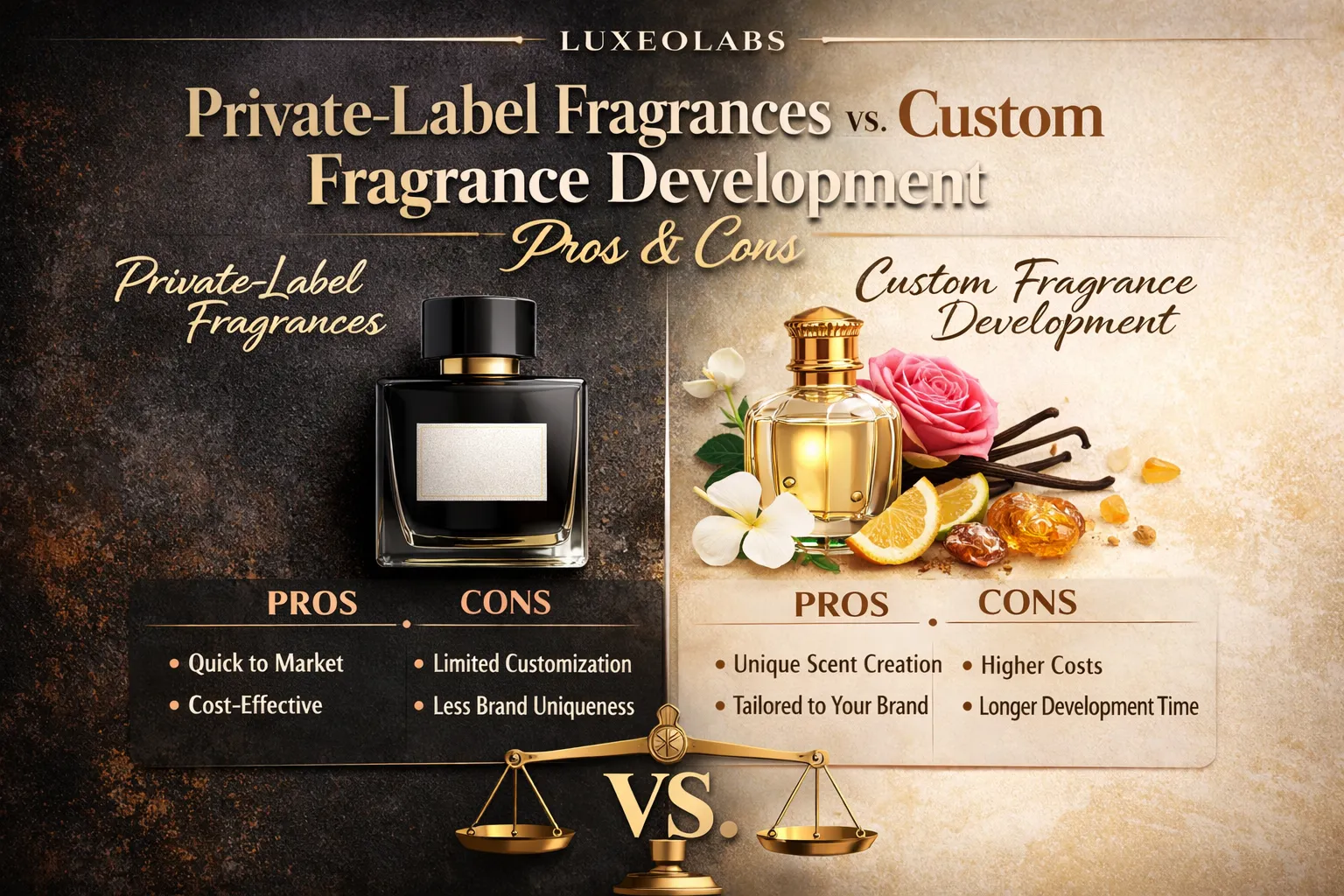
Private-label fragrances are fast and affordable. But they come with clear limits. These drawbacks matter if your brand wants long-term differentiation.
Limited Scent Exclusivity
Most private label fragrances use pre-made formulas. The same fragrance oil can appear across multiple brands. This makes it harder to stand out.
Restricted Scent Customisation
You can customise packaging and branding. But changes to the core fragrance oil are often minimal. Deep scent development is rarely possible.
Dependence on the Manufacturer
Quality, consistency, and compliance rest with private-label perfume manufacturers. Any lapse affects your brand directly.
No Ownership of the Formula
Brands do not own the fragrance formula. The same scent can be reused or sold to competitors.
Harder to Build a Premium Identity
Without unique custom scents, brands rely heavily on marketing. The product itself may feel generic.
Limited Innovation
Many private label perfume manufacturers focus on safe, popular profiles. Niche or complex aromas are less common.
What Is Custom Fragrance Development?
Custom fragrance development is the process of creating a unique scent tailored to a brand or individual. The fragrance is built from the ground up or carefully refined from an initial concept. It blends creativity with technical expertise. Perfumers design custom scents that reflect a brand’s story, mood, or emotion by combining precise notes and aroma chemicals.
Key aspects of custom fragrance development
- End-to-end process: Starts with discovery and scent direction. Moves through formulation, sampling, testing, and final approval.
- True uniqueness: Unlike private-label fragrances, the formula is exclusive to the brand.
- Signature identity: Helps brands create a recognisable scent that acts like an invisible logo.
- Wide applications: Used in custom perfume, candles, personal care, home care, and fabric care.
- Advanced technology: AI tools support fragrance profiling and speed up scent matching.
Pros of Custom Fragrance Development
Custom fragrance development helps brands and creators build scents that feel personal and intentional. It is ideal for companies that want custom scents with strong identity and long-term value. Compared to private-label fragrances, this approach offers greater control and originality throughout the fragrance manufacturing process.
Key benefits of custom fragrance development
- True uniqueness: Each custom fragrance is created from scratch. The scent is exclusive and cannot be reused by other fragrance oil brands.
- Stronger brand identity: Custom perfume acts as a signature. It helps brands stand out in crowded markets.
- Higher-quality performance: Custom scents often use refined fragrance oils and carefully selected aroma chemicals for longer-lasting performance.
- Emotional connection: Scents are designed to trigger memories and emotions, helping strengthen brand recall.
- Flexible applications: One formula can be used across perfumes, candles, personal care, and home products.
- Full control: Brands have visibility into ingredients, compliance, and scent direction.
- Premium positioning: Custom fragrance supports luxury branding and higher perceived value.
Cons of Custom Fragrance Development
Custom fragrance development offers depth and exclusivity, but it is not the right fit for every brand. Compared to private-label fragrances, it requires more time, resources, and planning throughout the fragrance manufacturing process.
Key challenges of custom fragrance development
- Higher upfront costs: Creating custom perfume involves R&D, multiple samples, and testing. This can stretch smaller budgets.
- Longer timelines: Custom scents take months to finalise due to formulation, stability testing, and approvals.
- Technical complexity: Without expert perfumers, fragrance oils may lack balance or fade quickly due to poor use of aroma chemicals.
- Ingredient sourcing risks: Natural materials can vary in price and availability, affecting consistency.
- Formula ownership limits: In many cases, brands do not fully own the final fragrance formula.
- High MOQs: Custom production often requires larger volumes, which may not suit early-stage brands.
Private-Label vs Custom Fragrance

Which Option Is Right for Your Brand?
The right choice depends on your goals, budget, and timeline.
Choose private-label fragrances if you want to launch quickly with low risk. This option works well for new brands, test launches, or seasonal collections. You get access to proven fragrance oils, lower MOQs, and quicker market entry.
Choose custom fragrance development if you want a true signature scent. This is ideal for premium brands that value exclusivity, long-term identity, and deep emotional connection. Custom scents take more time and investment but offer stronger differentiation.
Your brand vision should guide the decision.
Why Brands Choose Luxeo Labs
Brands choose Luxeo Labs for reliability, speed, and quality at scale.
Automated Precision Blending
Luxeo uses advanced blending systems. This ensures every batch stays consistent, even during high-volume production.
Scalability and Speed
Sampling and manufacturing timelines are fast. Brands can meet growing demand without delays or supply gaps.
Strict Regulatory Compliance
All fragrance oils follow IFRA-certified standards. Manufacturing also aligns with ISO 9001 quality and safety guidelines.
Luxeo is a fragrance oil manufacturer with facilities in the UAE and France. The team creates premium, tailor-made fragrance oils using innovation and precision. Brands worldwide rely on Luxeo for high-performance, compliant, and scalable fragrance solutions.
Frequently Asked Questions
What are private label fragrances?
Private label fragrances are perfumes produced by manufacturers and sold under your brand name using pre-developed fragrance oil formulas.
What is custom fragrance development?
Custom fragrance development creates unique custom scents from scratch to match a brand’s identity, using tailored fragrance oils and aroma chemicals.
Which option is faster to launch?
Private label perfume launches faster because the fragrance manufacturing process is already established.
Are custom perfumes more expensive?
Yes. Custom perfume projects cost more due to research, testing, and longer development timelines.
Can Luxeo Labs support both options?
Yes. Luxeo Labs offers both private-label fragrance manufacturing and full custom fragrance development services.