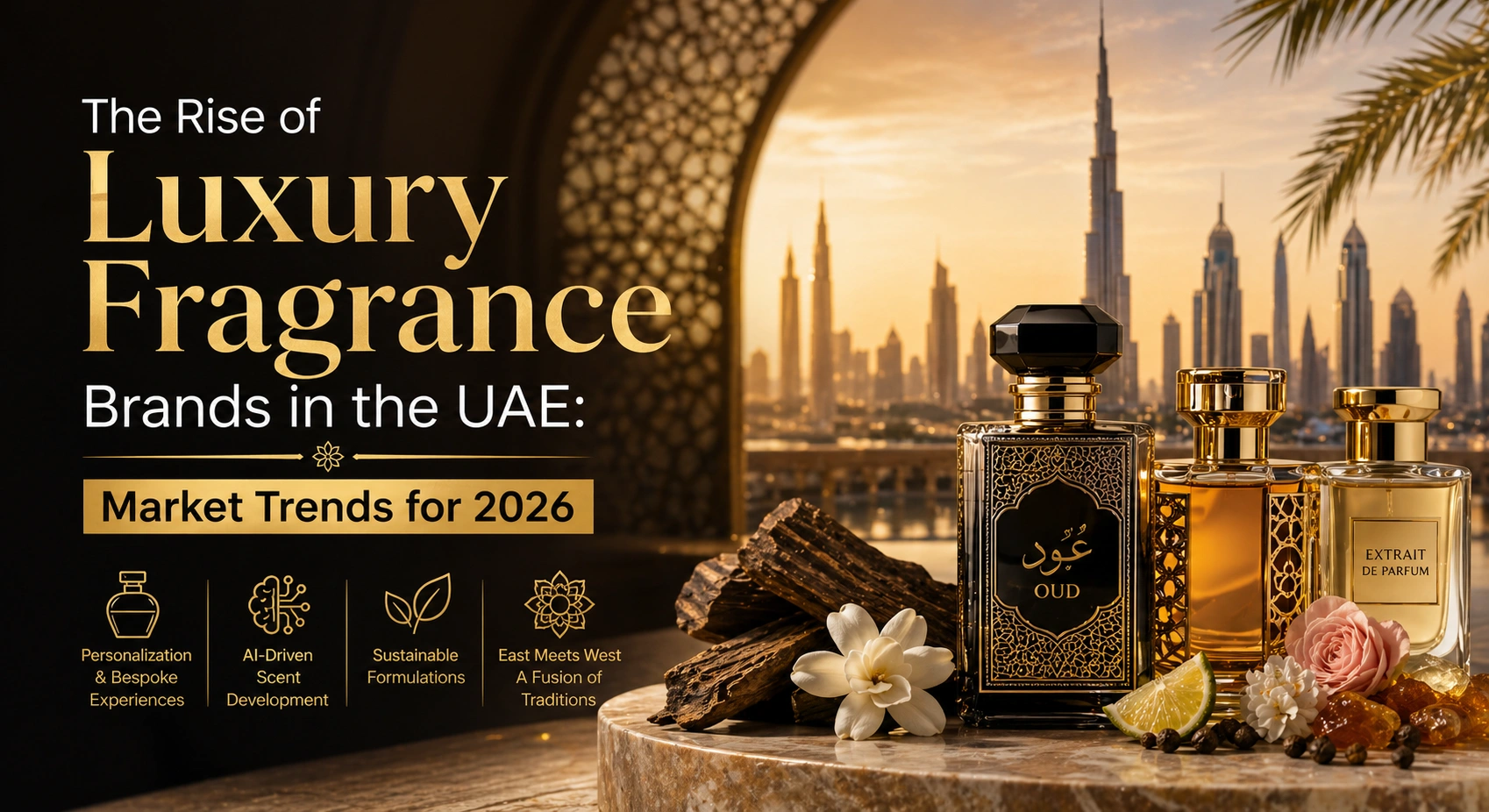
The UAE luxury fragrance market is growing fast. It was valued at USD 0.87 billion in 2024 and is projected to reach USD 1.15 billion by 2030. Arabic perfumes, led by oud, are at the center of this growth. In 2026, the biggest trends shaping the market are personalization, AI-driven scent development, sustainable formulations, and the fusion of Eastern and Western fragrance traditions.
Key Takeaways
Fragrance in the UAE is not a lifestyle accessory. It is a cultural cornerstone. In Emirati households, perfume is used not only on the body but also to scent clothes, homes, and even prayer areas. That cultural embeddedness creates a baseline of demand that most other markets simply cannot replicate.
The commercial numbers reflect it. According to Mordor Intelligence, the UAE fragrance market is expected to reach USD 0.91 billion in 2025 and grow at a CAGR of 4.81% to reach USD 1.15 billion by 2030.
Tourism will further accelerate this phenomenon. In 2023 alone, about 44 million foreign tourists visited Dubai. Luxury perfumes remain the primary souvenir and gift items purchased in airport duty-free shops.
According to Mordor Intelligence's GCC report, luxury fragrances account for 80.78% of the GCC fragrance market in 2025, growing at a 4.95% CAGR through 2031.
That is not a niche. That is the standard.
Arabic perfumes earn their luxury positioning through the quality of their ingredients, concentration, and longevity. Oud, extracted from the resinous wood of Aquilaria trees, carries a deep, smoky, and woody aroma that lingers for hours. It is often called liquid gold. Genuine oud commands prices that exceed many precious metals by weight.
The UAE climate also plays a role. Oud-based formulations respond well to warmth. Heat enhances oud's projection. Many Western fragrance formulas struggle in the same conditions.
In 2026, purchasing luxury fragrances is no longer an impulse buy but an experience. Retailers are providing customized scent consultation sessions and recommending perfumes based on each individual's personality traits, lifestyle, and preferences. In addition, some retailers leverage AI technology to provide customers with an olfactory assessment of their profiles.
Customized blends, bespoke scent creation, and personalized bottle engraving have now become the hallmarks of premium retailing in the GCC. Companies that view the sale of luxury perfumes solely as a transactional exercise are falling behind. On the contrary, those companies that create a consultative experience for consumers are earning their loyalty.
This opens a new frontier for product brand differentiation through custom fragrance development. Manufacturers that can offer a customized scent formula in large quantities can eliminate the largest bottleneck in bringing their products from design to market.
Pure oud perfumes are here to stay. However, the best-selling perfume brands in Dubai in 2026 are incorporating Arabian ingredients into their perfumes, using modern Western scent-creation methods.
French luxury houses have joined forces with their local distributors to create scents unique to Arab tastes. Younger generations prefer perfumes with fresh and versatile scent combinations. Perfumes that combine oud, floral, citrus, and spicy aromas appeal to male and female consumers alike.
It takes a company that combines French perfumery with extensive knowledge of regional tastes and preferences to do this right. Luxeo is uniquely positioned for such a task due to its perfumery and innovation team, including expertise gained at the company's Grasse creation center.
AI-based scent analysis tools are widely used across industries to understand customer preferences, identify emerging trends, and formulate bespoke scents. This is relevant for manufacturers in B2B fragrance manufacturing as well.
Companies leveraging AI in fragrance formula design will save valuable time on formulation and decrease their chances of failure. At Luxeo, artificial intelligence is combined with in-house perfumer talents to deliver scent samples in three business days and produce final products in seven. As speed-to-shelf becomes increasingly critical in the market, this gives us an undeniable competitive advantage.
According to research by the IMARC Group, the number of customers seeking sustainable, eco-friendly packaging for perfumes has been gradually rising. Consumers' preference for eco-friendly perfumes includes refillable bottles made from recyclable or biodegradable materials, helping both to reduce waste and lower overall expenditure.
Brands are resorting to bioengineering techniques as an alternative source of perfume ingredients. In doing so, it is possible to avoid sourcing issues related to rare and endangered raw materials.
In today's world, luxury perfume brands must provide transparency into their supply chains or risk alienating their target market. The 25 to 40-year-old demographic is interested not only in products but also in corporate social responsibility. The Luxeo commitment to corporate sustainability includes solar-powered facilities, a zero-waste manufacturing process, and a CSR roadmap until 2030.
Dubai is not just a consumer market. It is a global trade hub.
According to Jarsking Global, the UAE exported USD 682 million worth of perfumes in 2025. The country is forecast to export over 88 million kilograms of fragrances by 2026, placing it among the world's leading exporters, on par with France and the United States.
Government policy is also accelerating this shift. The Make It in the Emirates initiative creates incentives for manufacturers to produce locally, thus supporting domestic businesses.
A significant part of the infrastructure designed to promote local manufacturing is the Sharjah SAIF Zone. The Luxeo manufacturing facility located there provides all manufacturing services in one place: production, compounding, filling, packaging, and distribution worldwide.
The online channel is moving quickly. According to Expert Market Research, online retail in the GCC fragrance market is growing at a robust CAGR through 2031, driven by convenience, digital discovery, and broader access to niche and international brands.
The keyword "Arabian Perfume" and its variants saw search volume increase by more than 60% in 2025, providing significant visibility benefits for brands with a robust online presence.
However, physical sales remain significant. Specialty stores dominate the segment with a 58.90% market share in 2025, underscoring the importance of experiential retail, consultation, and scent testing.
Winning brands in 2026 do not have to decide between being an online retailer or a physical one. Instead, they are bridging the two worlds together. Moreover, they are associating with manufacturing partners that can offer a complete line of home fragrance, air fragrances, and personal care products, in addition to fine fragrances.
Why is oud so dominant in Arabic perfumes?
Oud is culturally significant across the Gulf region. It has been central to Emirati hospitality, religious practice, and daily life for centuries. Its molecular structure also performs well at high temperatures, making it ideal for the UAE climate. Modern brands are extending oud's appeal by pairing it with lighter Western notes to reach broader audiences.
How is personalization changing the perfume market in Dubai?
Personalization has become a core part of the retail experience. Leading boutiques now offer bespoke scent creation, engraved bottles, limited editions, and AI-driven scent profiling. Brands that offer a standardized shelf-and-sell model are losing ground to those that deliver consultative, custom experiences.
Where should fragrance brands manufacture to serve the UAE market?
Manufacturing in the UAE or within the GCC reduces lead times, simplifies import logistics, and aligns with government incentives. Luxeo's integrated facility in Sharjah offers custom fragrance development, contract manufacturing, and distribution from a single location, with ISO 9001, GMP, and IFRA certifications.