
Great fragrance is never an accident. It is a deliberate act of engineering.
While raw ingredients like Jasmine or Sandalwood provide the vocabulary of scent, perfume accords are the poetry; the structural DNA that transforms simple oils into an emotional experience. For product developers and brand owners, mastering this concept is the single most critical factor in launching a successful line.
Whether you are formulating a luxury, delicate fragrance or a high-performance functional scent, the magic and marketability reside entirely in the accord. It is the invisible architecture that decides if a scent will soar or fall flat. Let’s understand the mechanics of these accords, as the first step to owning our market.
Deconstructing the Term: What Is a Perfume Accord?
To the untrained nose, a fragrance is a singular smell. To the professional, it is a complex lattice of chemical interactions. So, what is a perfume accord in the strictest technical sense?
A perfume accord is a balanced blend of two or more raw materials (natural oils, absolutes, or synthetic aroma chemicals) that combine to create a unified olfactory impression. This new impression smells distinct from its individual components. It is the fundamental building block of all fragrance creation.
Think of it through the lens of colour theory. If you mix blue and yellow, you get green. You no longer see the blue or the yellow; you see a new entity. Similarly, in perfumery, if you mix Benzyl Acetate (a sharp, chemical jasmine scent) with Indole (a heavy, animalic scent), you create a rich, blooming “White Flower Accord” that mimics nature but possesses a character entirely its own.
The Distinction: Notes vs. Accords
It is essential to distinguish between a “note” and an “accord,” as these terms are often used interchangeably in marketing but mean very different things in manufacturing:
- Note: A single ingredient or raw material (e.g., Sandalwood Oil, Vanillin).
- Accord: A strategic combination of notes designed to create a specific effect (e.g., an “Amber Accord” made of Labdanum, Vanillin, and Benzoin).
Understanding the meaning of accord in perfume is the first step in communicating effectively with your fragrance house. When you request a “fresh” scent, you are likely asking for a “Citrus” or “Marine” accord.
The Architecture of a Scent: The Jean Carles Method
At Luxeo Labs, our approach to creating accord in perfume often draws on the foundational methodology of Jean Carles, the legendary perfumer who systematised the teaching of perfumery. A professional accord is not thrown together randomly; it is built with architectural precision.
Every robust accord consists of three structural pillars:
1. The Base (The Foundation)
This is the heaviest part of the accord, providing the theme and the longevity. Physically, these molecules have the lowest volatility and the highest substantivity (staying power).
- Role: It anchors the scent to the skin or substrate (wax/fabric).
- Common Ingredients: Patchouli, Musk (Galaxolide), Ambroxan, Vetiver.
2. The Modifier (The Character)
The modifier is the ingredient that gives the accord its specific personality. It directs the theme of the base.
- Role: It transforms a generic “wood” base into “Smoky Wood” or “Creamy Wood.”
- Common Ingredients: Eugenol (Spicy), Cis-3-Hexenol (Green), Aldehydes (Soapy/Clean).
3. The Blender (The Bridge)
Often the unsung hero of formulation, the blender smoothens the rough edges between the Base and the Modifier. Without a blender, the accords in perfume can smell “spiky” or disjointed.
- Role: It acts as a solvent and a harmoniser, expanding the diffusion (sillage) of the scent.
- Common Ingredients: Linalool, Hedione, Iso E Super.
If you are creating your own blends, understanding these ratios is critical. For a deeper look at how to handle these oils in practice, read our guide on How to Use Fragrance Oil as Perfume: Professional Formulation Techniques.
Major Accord Families: A Cheat Sheet for Brand Owners
Knowing the standard families of accords can speed up the development process. Here is a breakdown of the most commercially vital structures.
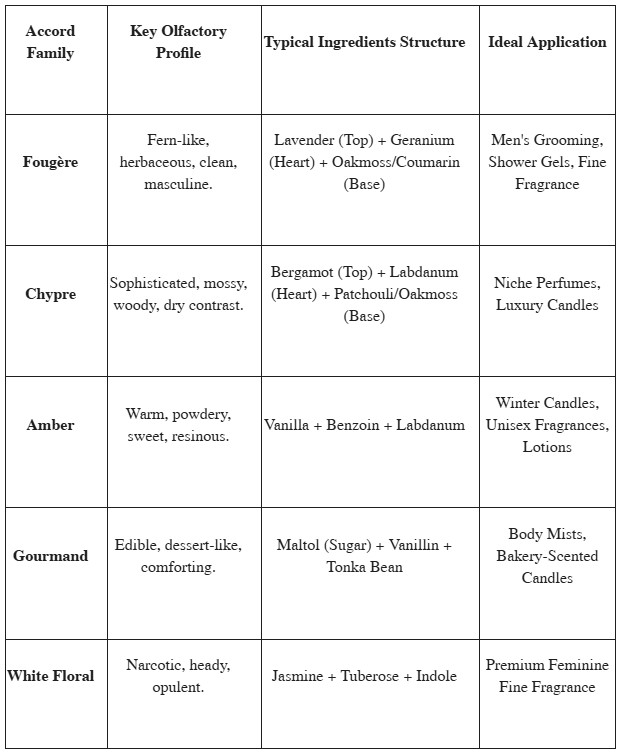
To see which of these families are currently dominating the market, check out our report on Most Popular Fragrance Oils 2025: Industry Trends and Consumer Insights.
The Vital Role of Synthetics in Accords
A common misconception in the consumer market is that “natural is always better.” However, in professional formulation, synthetic aroma chemicals are indispensable for creating recognisable perfume accords.
Many scents that consumers love simply cannot be extracted from nature. For example:
- The Sea Breeze Accord: You cannot distil the ocean. This accord is built entirely using synthetics like Calone to mimic the salty, aquatic air.
- The Muguet (Lily of the Valley) Accord: This flower yields no oil. The scent must be reconstructed using ingredients like Hydroxycitronellal.
By utilising high-grade synthetics, ensure that your accords in perfume are not only consistent from batch to batch but also sustainable. Relying solely on naturals can lead to supply chain volatility due to crop failures.
This careful balance of naturals and synthetics is also a key factor when choosing a manufacturing partner. For more on what defines a top-tier supplier, refer to our article on Best Fragrance Oil Companies 2025: Global Quality Leaders.
The Manufacturing Edge: Stability and Solubility
While the artistic side of perfume accords is fascinating, the industrial reality is that an accord must perform technically. A beautiful accord that separates in a shampoo bottle or vanishes in a candle melt pool is a failure.
1. Solubility Challenges
Different product bases attack accords differently. A citrus-heavy accord might work beautifully in an alcohol-based perfume but may cause cloudiness in a water-based room spray.
2. Chemical Stability (Schiff Bases)
Certain ingredients react with each other over time. For example, mixing Methyl Anthranilate (Grape/Orange Blossom) with certain Aldehydes creates a “Schiff Base.” This reaction can cause the liquid to turn dark brown or change colour entirely.
3. Regulatory Compliance (IFRA)
Some classic accords rely on ingredients that are now restricted due to allergens (e.g., Oakmoss or certain Musks). We utilise our “Green Chemistry” protocols to create modern, compliant versions of these classics that meet all IFRA Standards.
Conclusion
Understanding what a perfume accord is transforms you from a passive buyer into an informed partner. Whether you are looking to replicate a trending scent profile or invent an entirely new olfactory category, the magic begins with the accord.
At Luxeo Labs, we don’t just supply oil; we provide the architectural expertise to build your brand’s signature. From the stability of the base notes to the sparkle of the top modifiers, every drop is engineered for market success.
Frequently Asked Questions
What is the difference between a top note and an accord?
A top note is a single ingredient that evaporates quickly (like Lemon oil). An accord is a mixture of ingredients (Top, Heart, and Base notes) designed to create a unified smell (like a “Cola” accord). A perfume is made up of multiple accords working together.
Can a single perfume accord be used as a standalone fragrance?
Yes, some minimalist or “linear” fragrances are essentially a single, complex accord. However, most commercial perfumes are a composition of 3 to 5 major accords (e.g., a Citrus accord top, a Floral accord heart, and a Musky accord base).
How many ingredients are in a typical perfume accord?
A simple accord can be as few as 2 ingredients (e.g., a simple Rose accord). Complex accords, like a replication of Oud wood, can contain 20 to 50 distinct ingredients to capture every nuance of the natural material.
Why do my perfume accords smell different in a candle vs. a perfume?
This is due to the “base” interaction. Wax traps scent molecules differently than alcohol does. At Luxeo Labs, we reformulate the accords in perfume specifically for the medium, ensuring the “Hot Throw” (scent when burning) matches the cold smell.