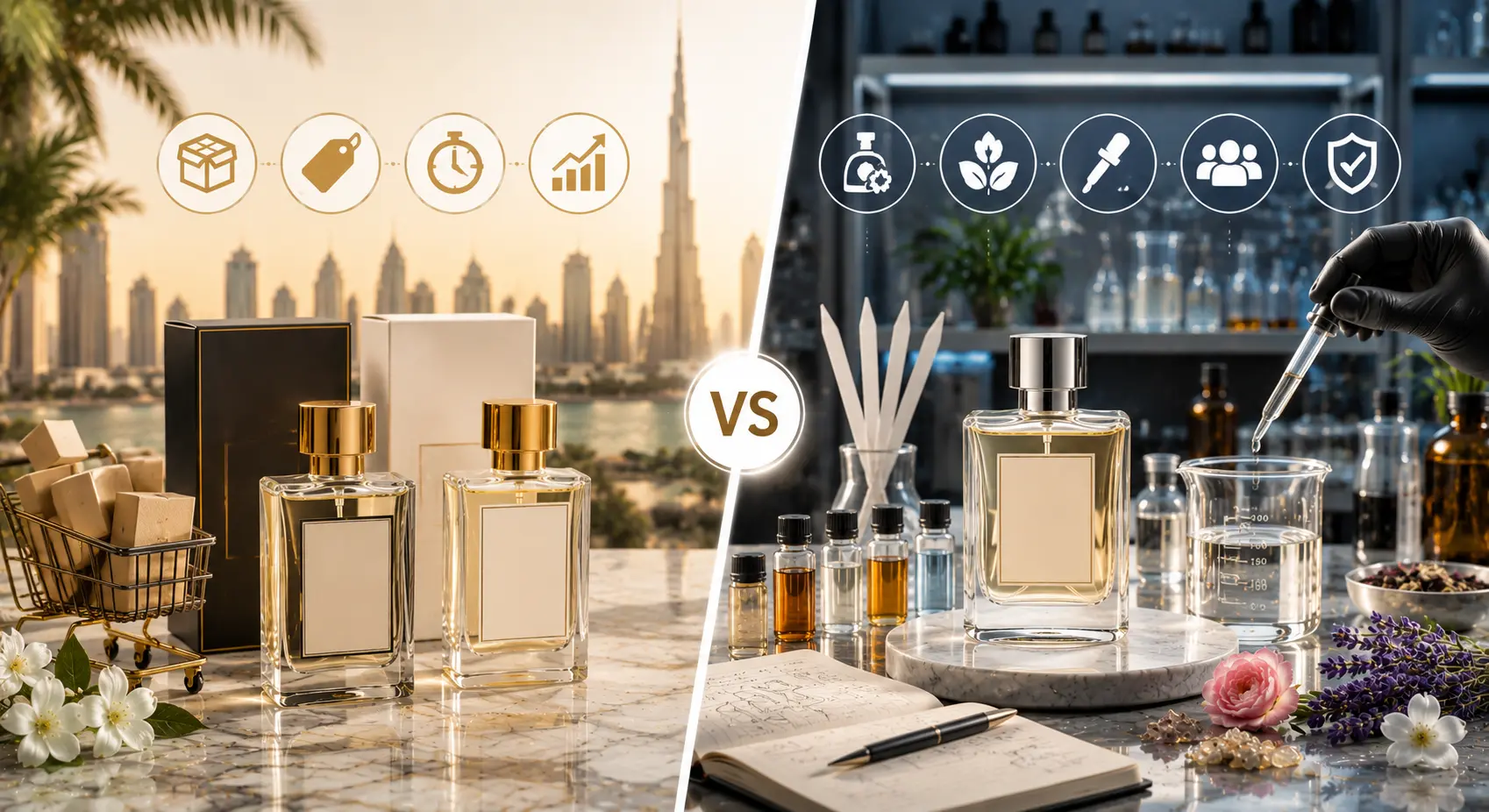
The UAE's fragrance market presents unique opportunities for brands choosing between white label perfume solutions and custom fragrance development. Whether you're launching a niche brand in Dubai's luxury retail scene or scaling across the GCC region, understanding these two models shapes your market entry strategy, investment requirements, and brand positioning. This guide covers the key factors UAE entrepreneurs and established brands must consider, from regulatory compliance to consumer preferences, helping you make an informed choice between speed-to-market convenience and brand differentiation through custom fragrance development.
The fundamental distinction between white label and custom fragrance models lies in control versus convenience. White label solutions offer pre-formulated fragrances that brands can rebrand and launch quickly, while custom development creates unique scent profiles tailored to specific brand identities and market positioning.
In the UAE market, this choice carries additional weight due to the region's sophisticated fragrance culture and regulatory requirements. Local consumers demonstrate strong preferences for both traditional Arabic scents and contemporary Western fragrances, creating opportunities for brands that understand these nuances.
The decision impacts everything from initial investment and timeline to long-term brand equity and market differentiation. LuxeoLabs' dual presence in Sharjah's manufacturing hub and Grasse's creative centre positions brands to use both models effectively within the UAE's regulatory framework.
White label perfume represents the fastest path to market entry in the UAE's competitive fragrance sector. Manufacturers maintain libraries of pre-developed formulations that brands can select, customise packaging for, and launch within weeks rather than months.
The UAE's favour brands that can respond quickly to seasonal trends and consumer preferences. White label solutions excel in this environment, particularly for brands testing market response before committing to custom development.
However, the model's limitations become apparent in Dubai's luxury retail environment, where scent uniqueness drives premium positioning. Brands sharing formulations with competitors struggle to establish distinctive market presence, particularly in the high-value segments that define UAE fragrance retail success.
Custom fragrance development offers complete creative control and market exclusivity, essential advantages in the UAE's brand-conscious consumer environment. The process involves collaboration between brand teams and perfumers to create unique scent profiles that align with brand identity and target market preferences.
LuxeoLabs' perfumers Flora and Ankush bring decades of experience creating fragrances that resonate with Middle Eastern preferences while meeting international quality standards. Their expertise proves particularly valuable for brands seeking to bridge traditional Arabic fragrance elements with contemporary market appeal.
The custom approach requires patience and higher investment but delivers sustainable competitive advantages. Brands own their formulations completely, enabling premium pricing strategies and long-term market positioning that white label solutions cannot match.
Success in the UAE fragrance market depends on understanding local dynamics that extend beyond simple product selection. These factors influence both white label and custom fragrance strategies, though their impact varies by approach.
Regulatory Compliance and ESMA Requirements
The Emirates Authority for Standardisation and Metrology (ESMA) mandates specific documentation and testing for fragrance products. Custom formulations require individual compliance processes, while white label solutions often include pre-cleared regulatory packages.
Cultural Sensitivity and Scent Preferences
UAE consumers demonstrate sophisticated preferences spanning traditional oud and rose compositions to contemporary Western fragrances. Successful brands understand these preferences and position accordingly, whether through white label selection or custom development briefs.
Distribution Channel Alignment
Dubai's luxury retail environment demands different positioning than Abu Dhabi's business-focused market or Sharjah's family-oriented consumer base. Product selection and pricing strategies must align with intended distribution channels.
Seasonal Demand Patterns
The UAE's climate and cultural calendar create distinct seasonal preferences. Ramadan, Eid celebrations, and summer travel patterns influence fragrance purchasing, requiring inventory planning that varies by product model.
Brand Building vs Speed Requirements
Established brands with clear market positioning benefit from custom development's differentiation advantages, while new entrants often prioritise white label's speed-to-market benefits for initial market testing.
Understanding the financial implications of each model helps UAE brands make informed strategic decisions. The cost structures differ significantly, affecting cash flow, inventory planning, and long-term profitability.
White label solutions offer predictable cost structures with lower barriers to entry, making them attractive for brands testing market viability or operating with limited initial capital. The faster revenue generation helps offset the reduced margins typical of shared formulations.
Custom development requires higher upfront investment but enables premium pricing strategies that improve long-term profitability. Brands typically recover additional development costs within 12-18 months through improved margins and market positioning advantages.
LuxeoLabs' scalable production capacity supports both models effectively, with volume pricing that improves economics as brands grow from initial launches to established market presence.
The UAE's regulatory framework requires careful attention regardless of chosen fragrance model. ESMA compliance affects product registration, labelling requirements, and ongoing market authorisation for all fragrance products sold within the Emirates.
Documentation Requirements
All fragrance products require detailed ingredient declarations, safety assessments, and product information files. White label suppliers typically provide these documents as part of their service packages, while custom formulations require individual preparation and submission.
Testing and Certification Standards
ESMA mandates specific testing protocols for fragrance products, including stability testing, microbiological assessment, and safety evaluation. The requirements align with international standards but include UAE-specific elements that affect compliance timelines and costs.
Labelling and Marketing Compliance
Product labelling must include Arabic translations for key information, ingredient listings in prescribed formats, and specific warning statements where applicable. These requirements affect packaging design and production planning for both fragrance models.
Ongoing Compliance Obligations
Brands must maintain current documentation and report any formulation changes to ESMA. Custom formulations offer complete control over this process, while white label solutions require coordination with suppliers for any modifications or updates.
Choosing the right manufacturing partner determines success regardless of fragrance model selection. UAE brands must evaluate potential partners across multiple dimensions that affect product quality, regulatory compliance, and business scalability.
Production Capacity and Scalability
Manufacturing partners must demonstrate capacity to meet initial requirements and scale production as brands grow. LuxeoLabs' three-ton daily capacity provides the scalability UAE brands need for regional expansion across GCC markets.
Regulatory Expertise and Compliance Support
Partners should offer thorough regulatory support, including ESMA compliance assistance, documentation preparation, and ongoing regulatory maintenance. This expertise proves particularly valuable for brands new to UAE fragrance regulations.
Quality Systems and Certifications
ISO 9001 certification, GMP compliance, and IFRA adherence indicate manufacturing partners' commitment to quality systems that meet international standards. These certifications also facilitate export opportunities beyond the UAE market.
Technical Capabilities and Innovation Support
Advanced formulation capabilities, analytical testing facilities, and perfumery expertise enable both white label selection and custom development success. Partners should demonstrate technical depth appropriate to brand requirements.
Supply Chain Reliability and Raw Material Sourcing
Consistent raw material availability and supply chain management affect product consistency and delivery reliability. Partners with diverse sourcing networks and inventory management systems provide greater business continuity.
Commercial Flexibility and Service Levels
Minimum order quantities, payment terms, sampling capabilities, and customer service responsiveness affect day-to-day business operations. Partners should align commercial terms with brand growth strategies and cash flow requirements.
The UAE serves as a gateway to broader GCC markets, making regional consumer preferences a critical consideration for fragrance strategy. Understanding these dynamics influences both product selection and positioning strategies across different fragrance models.
Traditional vs Contemporary Preferences
GCC consumers demonstrate sophisticated appreciation for both traditional Arabic fragrances and contemporary Western scents. Successful brands often bridge these preferences through careful scent selection or custom development that incorporates elements from both traditions.
Premium Positioning and Value Perception
The region's affluent consumer base supports premium pricing for differentiated products, favouring custom fragrance development's exclusivity advantages. However, value-conscious segments also exist, where white label solutions' cost advantages enable competitive positioning.
Seasonal and Cultural Influences
Religious observances, cultural celebrations, and climate patterns create distinct seasonal demand patterns. Brands must plan inventory and product launches around these cycles, with implications for both fragrance model selection and production planning.
Gender-Specific Preferences and Unisex Trends
Traditional gender distinctions in fragrance preferences remain strong in some GCC markets, while urban centres increasingly embrace unisex fragrances. This diversity requires careful market positioning and product portfolio planning.
Time-to-market considerations significantly influence fragrance model selection, particularly for brands responding to seasonal opportunities or competitive pressures in the UAE market.
White label solutions excel when speed determines market success, such as seasonal launches or competitive response strategies. The compressed timeline enables brands to capitalise on immediate opportunities without sacrificing quality or regulatory compliance.
Custom development's extended timeline reflects the collaborative process required to create unique formulations. While longer, this investment in development time typically yields superior market positioning and brand differentiation that justifies the additional time requirement.
The choice between white label and custom fragrance development ultimately depends on brand strategy, market positioning, and resource availability. A structured decision framework helps UAE brands evaluate their specific circumstances and requirements.
Brand Maturity and Market Position
Established brands with clear market positioning typically benefit from custom development's differentiation advantages, while new entrants often prioritise white label's speed and lower investment requirements for market testing.
Target Market and Price Positioning
Premium market segments favour custom fragrance exclusivity, while value-conscious segments may prefer white label solutions' cost advantages. The UAE market supports both approaches when properly positioned.
Resource Availability and Risk Tolerance
Custom development requires higher upfront investment and longer development timelines, suiting brands with adequate resources and patience for market development. White label solutions offer lower risk and faster returns for resource-constrained brands.
Long-term Strategic Goals
Brands prioritising long-term differentiation and premium positioning benefit from custom development's brand-building advantages, while those focused on immediate market entry or testing may prefer white label approaches.
The decision need not be permanent. Many successful UAE brands begin with white label solutions for market testing, then transition to custom development as they establish market presence and understand consumer preferences more clearly.
The choice between white label perfume and custom fragrance development shapes every aspect of your UAE market strategy, from initial investment to long-term brand positioning. White label solutions offer speed and simplicity for rapid market entry, while custom development provides the exclusivity and differentiation that premium positioning requires.
LuxeoLabs' thorough capabilities support both approaches through our Sharjah manufacturing facility and Grasse creative centre, ensuring UAE brands access the expertise and production capacity needed for regional success. Whether you prioritise immediate market entry or long-term brand differentiation, the right fragrance strategy positions your brand for sustainable growth across the GCC's sophisticated fragrance markets.
Most UAE manufacturers require 500-1,000 units for white label fragrances, with order values typically ranging from AED 15,000-35,000 depending on packaging specifications and fragrance complexity.
ESMA regulatory approval typically requires 14-28 days for custom formulations, including documentation review and compliance verification. [LuxeoLabs provides thorough regulatory support](https://www.luxeolabs.com/about-us) to streamline this process for UAE brands.
Yes, many brands begin with white label solutions for market testing, then develop custom fragrances once they understand consumer preferences and establish market presence. This staged approach reduces initial risk while preserving future differentiation opportunities.
UAE regulations require Arabic labelling for key product information, specific ESMA documentation, and compliance with both international standards and local requirements. Working with experienced UAE manufacturers ensures proper compliance from launch.
UAE consumers prefer lighter, fresher scents during summer months and richer, more complex fragrances during cooler periods. Cultural celebrations like Ramadan and Eid also influence purchasing patterns, requiring careful inventory planning regardless of fragrance model chosen.