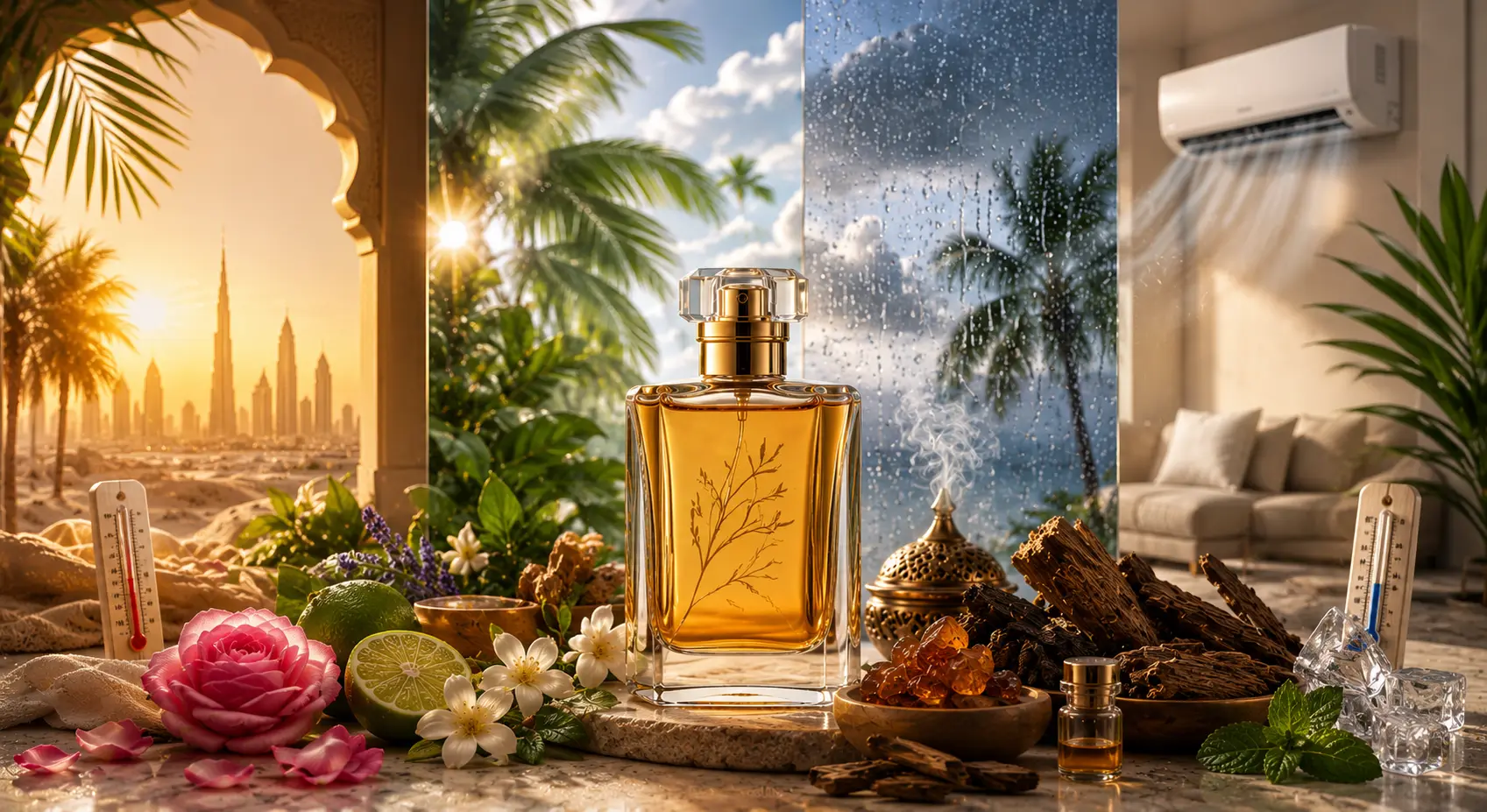
Creating fragrances that endure in extreme heat requires more than just choosing heavy base notes. Whether you're a perfumer, brand developer, or fragrance enthusiast, understanding the science behind heat-resistant formulations can transform fleeting scents into lasting olfactory experiences. In this guide, we'll explore professional techniques for developing long-lasting perfumes that perform exceptionally well in hot, humid climates like those in the UAE, drawing on advanced formulation chemistry and climate-specific expertise from LuxeoLabs, a manufacturer with facilities across the Middle East, France, and beyond.
Heat accelerates molecular movement, causing fragrance compounds to evaporate faster than intended. Humidity adds another layer of complexity, creating a moisture barrier on skin that can either trap or repel different scent molecules depending on their chemical structure.
The key lies in understanding vapor pressure, the rate at which molecules transition from liquid to gas. Research published in the journal Flavor and Fragrance confirms that high-volatility compounds, such as limonene, evaporate faster from skin than from glass, and that ambient humidity further accelerates their release into the air. Low-volatility base notes, by contrast, actually perform better as warmth helps them diffuse gradually.
Professional formulators working in hot climates typically use 40-60% base notes, compared to 20-30% in temperate-climate formulations. LuxeoLabs' amber fragrance oil exemplifies this approach, delivering rich, resinous depth that intensifies rather than fades in heat.
Synthetic musks like Galaxolide and Cashmeran act as molecular anchors, physically trapping lighter compounds. These large molecules create a slow-release matrix that extends wear time by 3-4 hours in temperatures above 35°C.
Advanced formulations incorporate fragrance molecules within microscopic capsules that rupture gradually with body heat and movement. Peer-reviewed research on temperature-sensitive microcapsules shows that double-walled capsule systems using temperature-responsive polymers can achieve sustained, controlled fragrance release, particularly effective in warm environments where heat acts as the release trigger rather than the enemy.
Heat-optimized formulations use 15-25% fragrance oil concentration (parfum/extrait levels) with reduced alcohol content. The higher oil ratio improves skin adhesion and slows evaporation.
Build fragrances in distinct molecular weight layers: volatile top notes for initial impact, semi-volatile heart notes for development, and non-volatile base notes for longevity. Each layer should complement the next as heat strips away the lighter elements.
Traditional Middle Eastern perfumery uses natural fixatives like benzoin, labdanum, and frankincense. These resinous materials form microscopic films on skin, creating physical barriers that slow evaporation.
Skin pH affects fragrance performance. Formulations adjusted to slightly acidic pH (5.5-6.0) show improved longevity in humid conditions, as the acidic environment slows molecular breakdown.
Replace standard ethanol with slower-evaporating carriers, such as fractionated coconut oil or jojoba. These oils don't evaporate at high temperatures, keeping fragrance molecules suspended on the skin longer.
Select aroma chemicals with high boiling points and low vapor pressure. Compounds like Iso E Super, Ambroxan, and Hedione perform consistently across a wide temperature range
Extended maceration (6-12 months) allows molecular bonding between different fragrance components, creating more stable compound structures that resist heat-induced separation.
Proper application can extend wear time by 50-70% in hot climates. Apply to pulse points before they warm up, immediately after showering, when skin is still cool and slightly damp. The moisture creates a base layer that helps fragrance molecules adhere better.
Layer application works exceptionally well in heat. Start with a matching body oil or unscented moisturizer, then apply fragrance to clothing fabric (test for staining first), and finish with skin application. This creates multiple scent reservoirs that release at different rates.
Avoid rubbing wrists together after application; this breaks down fragrance molecules through friction and heat. Instead, let the fragrance air-dry naturally for 30-60 seconds.
Middle Eastern perfumery has evolved over the centuries to withstand extreme heat. Traditional ingredients like oud, rose, saffron, and amber aren't just cultural preferences; they're chemically suited to hot climates.
LuxeoLabs' saffron fragrance oil demonstrates how traditional Middle Eastern ingredients can be optimized for modern formulations while retaining their heat-resistance.
Heat doesn't just affect fragrance performance; it can also permanently damage the molecular structure during storage. Keep fragrances below 25°C whenever possible. In UAE climates, this means air-conditioned storage is essential, not optional.
Dark glass bottles provide UV protection, but temperature control matters more than light exposure in hot climates. A fragrance stored at 30°C will degrade faster than one stored at 20°C in bright light.
For professional formulators, proper storage techniques become critical when working with heat-sensitive raw materials. Refrigerated storage for citrus oils and delicate florals can extend their usable life by 6-12 months.
With manufacturing facilities in Sharjah, UAE, and R&D centers in Grasse, France, LuxeoLabs combines European perfumery expertise with Middle Eastern climate knowledge. Their fine fragrance formulations are specifically engineered for hot-weather performance.
The company's ISO 9001 and IFRA compliance, the globally recognized standard covering maximum usage levels and safety restrictions for over 263 fragrance compounds, ensures that heat-resistant formulations meet international safety requirements while delivering superior performance.
LuxeoLabs' personal care fragrances incorporate advanced fixation techniques developed specifically for products used in high-temperature environments, ensuring consistent performance from Dubai to Mumbai.
Professional Tips from Middle East Fragrance Experts
Regional perfumers recommend the thermal layering technique: apply oil-based fragrances to cooler areas (behind ears, inside wrists) and alcohol-based fragrances to warmer pulse points. This creates different evaporation rates, extending overall wear time.
The cooling base method involves mixing fragrance with a small amount of menthol or eucalyptus oil. These cooling agents don't just provide comfort; they slightly lower skin temperature, slowing fragrance evaporation.
Traditional attar application, using a glass rod to apply tiny amounts to specific points, maximizes concentration while minimizing waste. This technique works particularly well with LuxeoLabs' concentrated fragrance oils.
Problem: Fragrance disappears within an hour
Solution: Switch to oil-based formulations or increase base note concentration. Consider perfume strength (20-30% fragrance oil) instead of eau de toilette (5-15%).
Problem: Scent becomes overwhelming in heat
Solution: Apply less product to more pulse points. Heat amplifies projection, so reduce quantity rather than avoiding fragrance entirely.
Problem: Fragrance smells different in the heat
Solution: This is normal; heat changes the evaporation sequence. Choose fragrances specifically formulated for hot climates, where this effect is anticipated and balanced.
Problem: Skin irritation in humid conditions
Solution: Switch to alcohol-free formulations or reduce application frequency. Humidity can increase skin sensitivity to certain fragrance compounds.
Start with one excellent heat-resistant fragrance rather than multiple mediocre options. Look for formulations with 15%+ fragrance oil concentration and prominent base notes. LuxeoLabs' home and air care solutions demonstrate how heat-resistant principles apply beyond personal fragrance to ambient scenting.
Consider seasonal rotation: lighter, fresher compositions for extreme heat (45°C+) and richer, more complex fragrances for milder hot weather (30-40°C). This approach maximizes both comfort and longevity across a wide range of temperatures.
Invest in proper storage solutions; a small wine fridge dedicated to fragrance storage pays for itself by extending product life and maintaining performance quality.
Creating long-lasting perfumes for hot, humid climates requires understanding both the science of molecular behavior and the practical realities of extreme weather. By focusing on heat-resistant ingredients, proper formulation techniques, and strategic application methods, it's possible to achieve exceptional longevity even in challenging conditions.
LuxeoLabs continues to innovate in this space, combining traditional Middle Eastern perfumery wisdom with modern formulation science to create fragrances that truly perform when the temperature rises.
A well-formulated parfum concentration should last 6-8 hours in 40°C+ temperatures, while eau de parfum typically lasts 4-6 hours. Oil-based formulations often outperform alcohol-based ones in extreme heat.
Woody notes like sandalwood and cedar, resinous materials like amber and oud, and synthetic musks perform exceptionally well. These have low vapor pressure and actually benefit from warmth for better diffusion.
For daily-use fragrances, cool room temperature (20-25°C) is sufficient. Reserve refrigeration for long-term storage of unopened bottles or heat-sensitive citrus-based fragrances that you use occasionally.
Yes, but start with base note-heavy compositions using quality fragrance oils. Focus on 60-70% base notes, 20-30% heart notes, and minimal top notes for hot-weather performance.
Heat accelerates the evaporation of volatile compounds while enhancing the projection of stable base notes. Fragrances with balanced formulations for hot climates are designed to account for this effect, maintaining consistent scent development as lighter notes fade.